Category Archives: How Trees Grow

Xylem

The xylem and the phloem are the vascular system of a tree; they transport fluid to and from every cell in the plant, via structures that branch, divide and become very small – small enough to be able to reach every cell. But xylem and phloem don’t transport the same substance, like our blood vessels do. Instead the xylem carries water and dissolved nutrients up from the roots, and the phloem carries the products of photosynthesis (‘photosynthates’) from the leaves to other parts of the tree. This post is about xylem, I’ve also written one about phloem.

As mentioned, the function of xylem is to transport water (and nutrients) throughout the tree. Although as has been the case throughout the creation of this website, I’ve learned that plants are never as simple as they seem! Recent research has found many other substances in xylem sap as well as water and nutrients, including plant growth regulators, sugars and proteins. This studyref into poplar xylem sap found six plant growth regulators, 124 plant metabolites including salicinoids, coumarins and benzoates, and 289 proteins with major groupings including proteins related to defence, cell wall-related processes and catabolic processes (breaking down sugars).

There is evidence that xylem is used for translocating sugars from storage organs such as roots particularly when photosynthesis is not operating (eg. for deciduous species before they break bud in the early spring). For example “birch, which blooms in late winter, clearly transports hexoses in the xylem with a potential of providing nutrients to the developing tissues at rates that equal or exceed those provided through the phloem”. ref

The majority of water-conducting xylem in a tree is in fact mainly made up of dead cells. This makes sense because living cells have cell membranes, vacuoules and other organelles which aren’t needed for the transport of water – instead what’s needed is an open space which can store water and pass it to the next storage space. In fact xylem vessels do not work for water transportation until they are deadref.

Water moves through the xylem from the roots and up throughout the tree, in a continuous stream, evaporating from the leaves via the stomata. This evaporation is what pulls water up against the force of gravity. Since the process relies on continuity, if air bubbles form in the xylem this can be a problem, as explained in this post: embolisms. You can read more about this in: trees’ water system.

When new xylem cells are born, they go through a process of strengthening the cell walls with substances such as lignin, hemicellulose and pectin among others, ref, then the cell dies (often because the vacuoule bursts) and its contents are cleared out (digested by enzymes)ref. This leaves a space for water to enter and occupy. In angiosperms, which use vessels for their xylem, death occurs within a couple of days, while in gymnosperms, which have tracheids instead, this happens a lot later – for trembling aspen and Norway spruce around a month.ref

For trees – which undergo secondary thickening – there are two producers of xylem cells – the vascular cambium (located under the bark) and the procambium (located in growing tips).

The vascular cambium is a single layer of cells responsible for producing the xylem which becomes the trunk and wood of the tree. It produces new xylem cells throughout the growing season – the cells deposited at the beginning of a growing season are the ‘earlywood’ and towards the end the ‘latewood’ (and yes if you want to know, there is also ‘transitionwood’). These make up the rings in the trunk of a tree, and are what thickens the trunk year after year. You’re probably aware that these rings can be used to understand historic climate variation and for the dating of all sorts of things – covered in the excellent book by Valerie Trouet “Tree Story, The History of the World Written in Rings”.

Although technically all xylem cells are ‘dead’ in the sense they don’t contain cytoplasm or the usual organelles like a nucleus, some are more dead that others! That is, after time some xylem cells aren’t used for water transport any more either, and their main role becomes a structural one, of holding up the tree. The ‘sapwood’ is the section of xylem still actively transporting water, and the ‘heartwood’ is the section which no longer does. For example in Picea Abies (what we use in the UK for a Christmas tree), once a tree reaches a certain age, “the width of the sapwood band remains more or less constant (on average 7.8 cm for dominant and 2.0 cm for suppressed trees)”ref. In certain angiosperms which regrow their active xylem every year (known as ‘ring porous’) there is only one active ring, and the rest is heartwood. In trees with less light which are ‘suppressed’ there is less need for water transport so the sapwood is thinner.

The structure of xylem is different between gymnosperms (conifers) and angiosperms – in fact this is one of the main differences between them. Conifers have only one type of xylem – ‘tracheids’ which are “are overlapping single-celled hollow conduits, closed at both end”ref. These cells are relatively small – ranging between 4-80μm in diameter, no longer than 5mm in length. For water to reach the top of the tree, it enters a tracheid, travels to the top and passes out through a pit connected to its pit pair in an adjacent tracheid, in this way it zig-zags its way up the tree. Here’s an image of a pit from pinus contorta, the open area around the outside is where the water flows through and the central area can be used to close the tracheid off if an embolism occurs.

https://www.srs.fs.usda.gov/pubs/chap/chap_2015_domec_001.pdf (fig 2.5)

As you can probably imagine, this isn’t a super-efficient way to transport water – conifers can’t transport water as quickly as angiosperms and can’t support the high levels of transpiration that angiosperms can.

Angiosperms have two types of xylem cells – narrow fibres which are used for strength, and wide, thin-walled vessels, which are used for water transport (Ennos). The wide vessels allow for much faster water transport, which enabled the larger leaves of angiosperms (which have higher transpiration rates) to evolve.

To see the difference between conifer tracheids and angiosperm vessels, this chart is from a studyref comparing the two. Note that both axes have a logarithmic scale, so the vessels are clearly a lot (100x or more) longer than the tracheids, and also 2-8 times the diameter.

The procambium (or ‘primary cambium’) is responsible for generating the xylem in leaves, roots and shoots. The initial xylem cells created by the procambium is called protoxylem and this in turn creates metaxylem.

In roots, the metaxylem is in the centre and the protoxylem next to it, with the phloem on the outside of the root: see the image below showing red protoxylem vessels, blue metaxylem vessels, orange procambial cells and green phloem cells (diagram from this paper). You can read more about roots and how they work in roots.

So what does it all mean for bonsai? Well the basic principle is that the tree needs water, nutrients and other substances like plant growth regulators, in every living cell and the xylem gets some of these substances there. Interrupting the xylem will slow down or stop cells accessing the inputs they need for growth, and potentially cause an embolism.

Bonsai activities which affect the xylem include wiring, carving, pruning, repotting and feeding.

Wiring too tightly may destroy the xylem on branches but there are two other layers which will be destroyed first – the bark and the phloem. Carving the sapwood will kill anything above the tree which is dependent on that sapwood. Pruning roots *may* kill the branches above if none of the rest of the root ball feeds those branches.

In general ring-porous trees are most vulnerable to xylem damage from the above because they have a small amount of sapwood, and rely on fewer wide vessels for their water transport. Popular ring-porous trees in bonsai include Oak, Ash, Black Locust, Catalpa, Chestnut, Hickory, Mulberry. Conifers aren’t ring porous, so are more tolerant of xylem cuts and interference. You can see what your tree is (diffuse or ring porous) on this website.

Because they are dead cells and no longer have a cell membrane as a barrier or the ability to create metabolites which can defend the cell, xylem cells can be (and are) populated by communities of microbesref. In one study of wild and cultivated olives, they found 5 phyla, 8 classes, 17 orders, 23 families, and 31 genera of bacteria, including Methylobacterium, Sphingomonas Frigoribacterium and Hymenobacter.ref

There is actually a xylem microbiome – just like there is for roots (the rhizosphere) – it is part of the endosphere. Xylem microbes include bacteria, fungi and oomycete organisms, some of which can be beneficial and others pathogenic. On the beneficial side some species of Methylobacterium are known to assist nitrogen uptake and to produce auxins which support plant growth. Other the other side, at least ten different microbes are know to cause vascular wilt – a destructive disease which targets the xylem – detailed in this article – including Verticillium (a fungus), Ralstonia solanacaerum (a bacteria) and Pythium ultimium (an oomycete).

Tree Phenology (or Seasonal Cycles)

The term phenology is used to describe the life cycle of a biological organism like a tree. Phenological events for trees include bud development, bud break, flowering, fruiting and leaf & fruit drop, as well as other unseen changes such as sap rising, seed development, root growth, cambial activity or hardening off of tissues for winter.ref

Tree phenology is entwined with the environment in which the tree lives. As there are a very large number of different climates and micro-climates within them, there are accordingly many different nuances in tree phenology, according to the location and environment. Even the same species can show widely different phenology between two different places (at least from a timing point of view).

So to really understand how phenology would play out for your own trees, you need to understand the species phenology and how it varies based on location. You’ll often find bonsai articles are specific to the location of the author which won’t always be relevant to you.

The main phenological events relate to a tree’s growth and reproduction. For example, roots stop growing below 6°C, buds break when the tree detects a low chance of frost in the future (which might damage the tender buds and shoots), photosynthesis, energy production and growth is highest when there is the most sun, and reproduction happens in conditions which most favour seed survival.

  • In the boreal forests – “high-latitude environments where freezing temperatures occur for 6 to 8 month”ref phenology is mainly driven by temperature, affecting the timing of the start of the growing season and thereby its durationref
  • Temperate-zone forests are located between the tropics and the boreal forest zone – they have hot summers and cold winters with high temperature variationref, and their phenology is also mainly driven by temperatureref
  • Mediterranean coniferous forests are mainly driven by water availabilityref
  • Australian ecosystems are extremely diverse and also subject to irregular events such as fire, drought, cyclones and flooding, which can affect phenological events, but a key driver is water availability.ref Where evergreens dominate in this ecosystem, flowering is the main phenological event.
  • In tropical forests which have less variation in temperature and usually high water availability, leaf shedding and growth is continuous, but reproduction (flowering and fruiting) demonstrates ‘mast’ timing effects associated with drier than normal conditionsref (ie. all trees fruiting at the same time every seven years)

In boreal and temperate areas the phenology is described in this article and summarised in the images below. But if you’re keen to understand the specific phenology for your tree in your area, you could consult google scholar.

The chart below shows the proportion of Eucalyptus loxophleba flowering at any given time in a seed orchard in the southwest of Western Australia. The highest proportion of flowering happened in spring (Sept-Nov in Australia) but a significant portion also happened in winter (June-Aug). Flowering fell to zero in the hot, dry summer (Dec-Feb).

https://www.nature.com/articles/s41598-020-72346-3/figures/2

This all seems a bit confusing given how many different variables there are, but there are some basic principles you can use from a bonsai perspective:

  • Trees in their growth phase (usually when there is plenty of sun and water) will be able to recover more easily from significant damage (such as large trunk chops or carving wounds) and fight any pathogens which might seek to take advantage of these.
  • Similarly leaf pruning during active growth will result in more buds activating.
  • Trees which are in a strong vegetative growth phase (growing leaves and stems) deprioritise root growth. Root growth gets a turn after the leaves establish.
  • Trees which have set buds but haven’t flowered yet – if you prune indiscriminately – you will lose flowers! There is a way to identify flower buds on your tree but it involves a bit of effort. Flower buds differentiate from vegetative buds at a certain point prior to flowering/leafing out. You can identify different looking buds on your tree, then remove one example of each. Cut it open and look at it under a loupe or microscope and you will be able to see which one was the flower vs the leaf or shoot. Or if you’re both patient and organised, take a picture of some your tree with buds and then with flowers – and you should be able to see what the different bud shapes are.
  • Storage of carbohydrates to storage tissues will take place during growth phases, and these will be used in turn when less photosynthesis is happening, to drive respiration and other processes requiring energy. Read more about how storage varies in roots here: Root Food Storage (or, can I root prune before bud break?)
  • If you’re a fan of wiring, doing this before a stem hardens off will allow you more bendability (although watch out for growth around the wire)
  • Depriving a tree of resources (water, nutrients) will mimic ‘hard times’ and cause it to respond accordingly phenologically – drop its leaves earlier, produce less flowers/fruit or not flower at all, or push out emergency growth (like adventitious buds/suckers)
  • I think it’s important to say that although the term ‘dormant’ gets used in relation to trees, this is a little misleading. Trees are living organisms and still need to maintain their metabolism even during winter. This includes respiring (using oxygen and stored energy to maintain metabolism), photosynthesising (for any tree with green areas remaining including evergreen trees but also deciduous trees with green stems), transpiring (even deciduous trees still transpire during winter, although a lot less than when they have leaves and in particular they take up water to swell the buds prior to bud breakref), and taking up nutrients through the roots. As I’ve written elsewhere in this site, root growth can happen above 6 degrees C, so your tree may well be more ‘alive’ than you think during winter.

I know there will be people saying at this point – just tell me what happens when!! For those people here are some general guidelines for temperate zones.

You can expect conifers to cease xylem production in autumn and root growth in winter, and to pick these up again between 2-7 degrees C (cambium) and 6-9 degrees C (roots). Buds will burst from early spring onwards depending on the species and latitude and pollen cones will release their pollen. Seed cones will start maturing, which can take just one summer (Picea, Tsuga) or one or more years plus the summer (Pinus, Cedrus). Next year’s buds and future years’ seed cones will form in late summer, and old needles (2+ years depending on species) will drop in late autumn. Mature seed cones will drop or release seed from late autumn onwards. ref1 ref2 ref3 Hardening leaves for the winter also happens in late autumn.

The main differences for angiosperms in temperate zones revolve around xylem production, leaf growth and senescence within the season, and flowers & fruit. In spring xylem creation will commence – in diffuse porous trees buds can break earlier but ring porous trees need to create the new season’s xylem layer before budding. Some trees will burst bud based on temperature and others on photoperiod (or a combination of the two).ref Whether flowers or leaves come first depends on the species, and the timing of flowers is hugely variable (Frank P Matthews has a list of flowering times for ornamental trees in the UK). The leaves of deciduous trees start a structured senescence process in the autumn, when they remove cholophyll and other molecules from the leaves for storage and recycling (hence the colour changes). After this has been completed the tree creates a cork layer at the base of the leaf causing it to drop off. Fruit develops throughout the growing season and depending on the species will drop off from early summer through to winter.

There’s one more phenological domain which I haven’t covered in this article – the phenology of the microbiome. This is a whole other kettle of…microbes…and might be the subject for a future post.

Finally, the fabulous In ‘Defense of Plants’ podcast has covered phenology in this podcast episode.

Defoliation

There are quite a few research papers about tree defoliation because this can be caused by insects, creating a problem for the forestry industry. Defoliation is used on deciduous trees in bonsai to completely regrow a deciduous tree’s leaves, resulting in ramification and smaller leaves. This isn’t a practice for conifers, or at least, not for most of them, as many conifers simply can’t regenerate very easily and the effect will be weakening of the tree and not ramification. Although I must note here that my 2022 summer watering disaster caused a small larch forest of mine to defoliate and it looked fantastic after the foliage regrew!

Complete defoliation is a pretty drastic practice from the tree’s perspective and a double whammy – as not only does the tree have to use its stored energy reserves to regrow its leaves, it doesn’t have any energy coming in until those leaves are regrown. Defoliation significantly reduces the total stored carbon in a tree, and there is a point at which mortality occurs – one study found that once stored carbohydrates were less than 1.5% of the usual level, this will kill the tree.ref

As described in this article about the effect of grazing animals, “Plants adjust to conditions of chronic defoliation and the associated reduction in whole-plant photosynthetic rates by altering resource allocation patterns and reducing relative growth rates.”ref Although the article is focused on grasses, which are a different branch of the Plantae family to trees, it says that “root elongation essentially ceases within 24 hours after removal of approximately 50% or more of the shoot system…[and there is]…a rapid reduction in nutrient absorption”. So basically by defoliating 50% or more the roots will stop growing and nutrient absorption will reduce. Interestingly, several studies reported that photosynthetic capability of the remaining leaves on defoliated plants actually increases – perhaps a result of the resource allocation pattern change mentioned above.

The effect of defoliation is to force a deciduous tree to use the stored energy it has built up in the growing season straight away, instead of leaving it for the next season. Because of this, the tree doesn’t have the energy reserves to grow a full set of leaves at the same size it would normally, so it compensates by growing smaller leaves. Since this technique uses up stored energy, there isn’t much left for other types of growth, so it’s not a technique you would use if you were trying to thicken a trunk or grow branches.

This studyref found that a 50% defoliation of prunus saplings reduced their growth rates for the following 5 years and brought forward bud burst for a similar period, while this oneref found that larch recovered well from defoliation, but pinus did not. This oneref said that partial and complete spring defoliation reduced first-year diameter, height, and volume growth of 4-year-old loblolly and slash pines.

This article says that “scientists found that growth was reduced in both half and entirely defoliated trees in the short and long-term…both half and entirely defoliated trees had less leaf area than control plants. Defoliated trees also allocated more carbon for storage than control trees with no defoliation.”ref This suggests that defoliation in some way teaches your tree to divert resources to storage instead of foliage, not just once but into the future. Which means you really don’t want to do this while you are still establishing the branch structure and ramification because these will slow.

Interesting, Harry Harrington reports that some species don’t respond to complete defoliation by growing smaller leaves, instead they grow a small number of large leavesref. So overall a complete defoliation may be an unnecessarily unpredictable and heavy-handed way to achieve leaf reduction. One could hypothesise that defoliation of a tree which follows a fixed growth pattern (read more in Extending Shoots) might result in a greater leaf reduction effect, because buds and nascent leaves are not sitting there waiting to burst, they need to be completely regrown. But one could also hypothesise that this type of tree might struggle to regrow any leaves at all, depending on the weather conditions.

There are less drastic options than removing the entire foliage of a tree all at once – you can remove half of it for example, or do it in stages, so that new leaves can grow before the remove the next batch. It seems like you should be able to achieve a similar effect with constant low-level leaf pruning throughout the growing season, combined with bud pinching at the start of the season. A more gradual approach would allow photosynthesis and energy generation to continue, without stopping root extension and nutrient uptake, while still regrowing leaves and increasing ramification. It may be however that the shock of something more drastic is what’s needed to reduce leaf size significantly because the resources to regrow are shared more widely. An experiment for someone?

The timing of defoliation is really important. The tree needs to have had enough time with its new leaves to generate good energy stores for the next season and enough time to regrow and harden its leaves against frost. Somewhere in the middle of the growing season allows for both of these to happenref.

Ramification of Branches and Foliage

After establishing trunk and branch structure, ramification (a fancy word for ‘branching’) of branches and foliage (as well as roots) is a key goal of bonsai. This makes a tree look older and more sophisticated, and gives the bonsai enthusiast options for continued development of the tree.

Ramification is created by branching the stems. Stem branching usually* requires buds, as a new bud creates a new stem. The pattern of stem branching for a particular species will depend on its ‘phyllotaxy’ (leaf morphology) and pattern of buds.

Usually in bonsai we don’t want more than two stems from the same location, the general guidance is to fork into two at any given junction. This is because strong growth of multiple branches at a junction leads to a bulging area on the trunk which bonsai judges don’t like. In the real world, many trees have reverse taper and bulging branch junctions though, so it’s your call. To avoid this situation, remove buds which are in places you don’t want by rubbing or cutting them off.

To improve ramification, you need to encourage as much budding as quickly as possible, then select the buds you want to develop. Pruning the growing tip is the main way to encourage budding, because pruning removes the apical bud (the dominant bud at the end of the stem), diverts resources into buds lower down the stem and sensitises those buds to respond to auxins and develop into shoots. In deciduous trees this should result in at least two buds generating from the stem instead of the one which was there. Another great way to create ramification on deciduous trees is through bud pinching – see Harry Harrington’s detailed explanation of how to do this. Bud pinching removes the entire primary meristem except for two outer leaves, this encourages the buds at those leaf axils to grow, along with two new buds at their bases.

Different species have differing abilities to respond to pruning, so try to get a sense by observing your tree of how well it will cope. Deciduous trees are designed for regeneration so in general they take pruning reasonably well, although if you take it too far they might send out suckers instead of new buds from the branches. With evergreen conifers you want to ensure there is some foliage and at least some buds remaining after you prune, otherwise it may not regenerate (unless it’s a thuja, or a yew, these guys are refoliating machines). I have cedrus seedlings in my collection and by cutting back the apical leader from not long after they germinated, and every year since, they have become extremely bushy and well-ramified (although, at the cost of developing a think trunk).

Gratuitous image of one of my cedar bonsai

Anything which stops or prevents tip extension will drive bud activation and ramification further back on the tree. In the case of conifers, the presence of flowers on the growth tips (as you see in juniper) has this effect as well, and can cause back budding. Lammas growth (a second flush in summer) can give you another round of ramification as long as you’ve pruned beforehand (otherwise it will just add to the existing stems).

Research has found that bud outgrowth is “controlled by plant hormones, including auxin, strigolactones, and cytokinins (CKs); nutrients (sugars, nitrogen, phosphates) and external cues”.ref In particular the sugar sucrose has been identified as a key driver for promoting bud outgrowth and accumulating cytokinins – this is generated by photosynthesis.

In one study on apple trees, foliar application of a synthetically produced cytokinin 6-benzylaminopurine (BA) was found to generate three times the lateral bud growth on currently growing shoots compared to controls (but not on old growth)ref and at the same time reduced the length of the main stem. BA was used to encourage better growth of bean sprouts in China before being bannedref and has been shown to increase the number of leaves (ramification!) on melaleuca alternifolia treesref (melaleuca is the source of tea tree oil), and on some conifersref. Could BA (also known as 6 BAP) be useful in bonsai? You can (like most things) buy this product in foil bags on ebay, but there is a product in the orchid world called Keiki paste which also contains 6 BAP – so maybe some judicious use of ‘crazy keiki cloning paste‘ might also help ramification and shoot development in your trees?ref You can also purchase BAP (as its also known) from vendors involved in hydroponics and suchlike as it’s used in in-vitro plant micropropagation.

If you baulk at paying £18 for 7ml of keiki paste, there is one other source of cytokinins which is a lot cheaper, more sustainable and clearer in its provenance – compost. This study found that compost created particularly from waste collected throughout springref contained 6 BAP. Frustratingly there weren’t any free to read articles analysing compost leachate for cytokinin content, but if it’s in solid compost it’s a fair assumption there are cytokinins in leachate as well. Which makes me feel a lot better about the £300 I recently spent on a Hotbin composter! Which incidentally, produces gallons of leachate, which can be diluted and added as a liquid fertiliser.

* I’ve recently read a study which states that “apical meristems can be surgically divided into at least six parts and these then become autonomous apical meristems.”ref What this suggests is that you could slice growing tips into 6 (or better, two since we don’t want more than two stems from a node) and they would become two stems instead of one! One to try next spring.

** By the way – it’s not auxins which cause apical dominance! Check out page 215 of this book, it’s nutritional status and phyllotaxy which determine the apical stem’s sensitivity to auxin which is present.

Shoots

This is a rewrite of my original post on shoots, now I know a *lot* more…

So what are shoots? They are the vegetative growth which comes from buds, extending to create new stems. Since stems create the architecture of a tree, shoots are really important when it comes to bonsai.

There are three key concepts to know about when it comes to shoots. The first is the existence of long and short shoots, the second is the way in which different shoots are formed and the third is the concept of the internode.

I had never heard of long and short shoots before researching this site, and I have since found that many articles and books don’t really talk about the fact that many species of tree possess two types of shoots. Shoot differentiation (as it’s known) is present on the vast majority of deciduous angiosperms (flowering trees), all deciduous gymnosperms, and quite a few (around 25%) of evergreen gymnosperms as well, particularly conifers.ref

In these trees, two different types of shoot develop – long shoots and short shoots. Long shoots are exactly as described – they have a terminal bud which continues to build up the length of the shoot over time so it becomes (relatively) long. Short shoots meanwhile don’t persist beyond a limited number of years, they are much shorter than long shoots and have many fewer nodes. Both types of shoots can have leaves, flowers, cones and fruit, but only long shoots can create the long-term architecture of the tree. Importantly, aside from their structural trunk and branches older trees mostly grow short shoots, which is why they look more ramified.ref

In some species (such as pines), short shoots – otherwise known as fascicles – are a feature of the mature vegetative phase of the tree, and don’t appear in the juvenile phase nor with juvenile foliage. An interesting side note is that fascicles can be used to propagate trees with needle leaves, the fascicle is treated like a cutting and placed in rooting hormone and well drained medium – the reason this works is because the fascicle is actually a short shoot and not a leaf.ref

Below is an example of Cedrus libani where the clusters of needles (N1) are on the short shoot (S), and occasionally along the long shoot (L) there are individual needles (N2).

https://www.researchgate.net/figure/Shoot-and-needle-characteristics-of-Cedrus-libani-A-Approximately-6-year-old-spur-shoot_fig1_303469784

A fascinating – and useful for bonsai – attribute of short shoots is that they almost always have more leaves than the equivalent long shoot. In angiosperms, short shoots have multiple smaller leaves with an almost identical leaf area to a single leaf grown from a long shoot (see example A below).ref And in gymnosperms short shoots have many more leaves and leaf area than long shoots – examples D and E below show the leaves on a short shoot (right hand side) compared to the individual long shoot leaves (left hand side) on larch and dawn redwood.

(source: https://beckassets.blob.core.windows.net/product/readingsample/10943560/9783510480326_excerpt_001.pdf)

So hopefully you can see that short shoots are fantastic for ramification! But not so fantastic for building the structure of the tree, since they don’t persist. So how can you tell which is which? Very simply short shoots are smaller, have a lot more leaves, and fall off when their time is up. Often in gymnosperms they will have cones at the end of their leaves.

You may not have realised that whilst the ‘leaflets’ on Cupressaceae species such as dawn redwood, cypress and juniper may appear to be compound leaves, instead they are actually short shoots. When their life comes to an end, the entire short shoot abscises (falls off) along with its leaves. Similarly for pines, what you might know as ‘fascicles’ are actually the short shoots, and on pines only the short shoots bear photosynthesising leaves (needles). Eventually they will fall off.

In angiosperms, a short shoot usually develops from the bud in the leaf axil of the long-shoot leaf, arriving the next season. In gymnosperms, it depends on the species. In Cupressaceae a bud will be sitting at the base of the short shoot so another one should grow once it falls off. In Pinus short shoot buds sit in the long shoot leaves towards the base of the long shoot, and they are positioned at the base of the long shoot bud.ref In Ginkgo both short shoots and long shoots can come from any bud on any type of shoot.

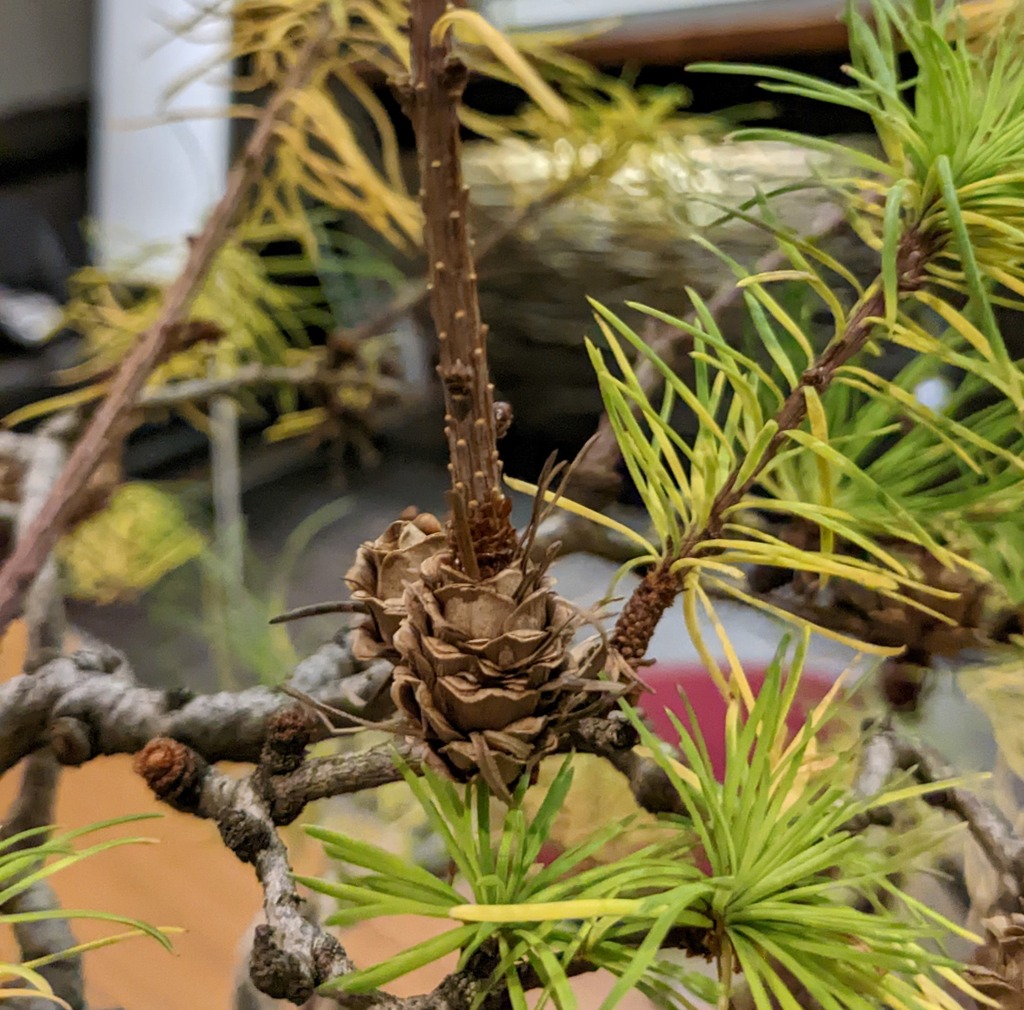
Below is a picture of some interesting behaviour I’d never seen before – this Japanese larch belonging to a member of my bonsai club produced buds and new stems right through the middle of its cones. Pollen and seed cones on larch are terminal organs growing only on short shootsref – which means they aren’t supposed to extend. But Larix is known to be able to change the type of shoot from short to long if damaged (which may have been triggered by the hard pruning it received).ref So in this case what had been a short shoot destined to eventually fall off, instead turned into a long shoot.

So what does it all mean? From a bonsai point of view, the first thing is to work out if a tree has shoot differentiation. If it is deciduous, it will, and if it is a gymnosperm, it still may even if evergreen – gymnosperms which have shoot differentiation include Pseudolarix, Taxodium, Sequoia, Cedrus, Larix, Ginkgo, Pinus & Metasequoia. Understanding the difference between short and long shoots will allow you to understand where foliage will ramify, and where the long-term structure of the tree can come from. On trees which don’t have shoot differentiation, any stem which has a vegetative bud can be used to develop the shape of the tree.

So now we know that long and short shoots exist in many trees, let’s turn to how those shoots form. According to Thomas (2018) , there are three options.

Option 1 is ‘fixed’ or ‘determinate’ growth. These trees preform every part of the shoot in the bud, so they extend very quickly (a few weeks) and then stop. If they are young (less than 10-15 years old) and have the right conditions, they may do this a second time around the start of August (in the Northern hemisphere), this is known as Lammas growth. The shoots from these trees developed based on the conditions at the end of *last year’s* growing season.

Option 2 is ‘free’ or ‘indeterminate’ growth. These trees have only some preformed leaves. Once extended the shoot will continue to produce other leaves from scratch in a continuous fashion. Often these are found in the tropics or warmer climes (my potted Eucalyptus never seem to stop producing leaves even during winter).

Option 3 is ‘rhythmic’ growth. These trees extend in recurrent flushes, with multiple cycles of growth and bud formation during the season.

Outside of the tropics, towards the end of the growing season all trees will stop shoot and leaf growth according to their phenology, in order to complete the formation of buds for next year. If conditions are not good, these buds will be fewer and contain fewer leaves. To see a list of which trees have which types of growth see the Growth Types Table. The relevance to bonsai is that trees with determinate growth are only going to give you one or at most two cracks of the whip in a given season. Those with indeterminate growth might be easier to develop since they will keep extending as long as the conditions are suitable.

Interestingly one study on lammas growth (second flushing) found that 73% of this occurred from lateral buds. We’d obviously love to have this in bonsai as it helps ramification within the same growth season.ref This articleref summarising lammas growth factors says that it can be encouraged by warmer temperatures (Pinus densiflora), extra watering (Pinus sylvestris), nitrogen fertiliser (Pinus sylvestris, Pseudotsuga menziesii) and applying a blackout treatment for less than 2 weeks early in the summer (Picea abies). So from a bonsai perspective see if you can encourage second flushing to generate those lateral buds.

And finally we come to internodes – these are the length of the shoot between each successive leaf. In general bonsai afficionados are looking for short internodes so they can achieve compact, dense foliage. The factors which affect internode length when a tree grows are the same as for any other type of growth – genetics, plant growth regulators and availability of nutrients. Shorter internodes can be achieved by (1) shoot pruning, (2) thigmomorphogenesis and (3) starvation.

If you allow a shoot to extend naturally (and it has no competing stressors), it will prioritise resources into growing as long as it can and the growing tip will suppress the growth of any lateral shoots below it – because the driving force for a tree is to grow large and establish the biggest exposure it can to sunlight. An angiosperm will grow a series of internodes with leaves at each point. What I have observed from looking in my garden is that the internode length on an angiosperm tends to start small (or in some cases leaves are grown directly at the node as well), then increase in size, then reduce again.

To get the smallest internodes, you should prune off the growing tip once the first pair of leaves and the first internode has grown. If leaves have grown at the node, you could remove the shoot altogether (there will be no internode in this case). New shoots will grow from buds in the leaf axils, and if you keep doing this, you will always retain the short first internode and increased ramification.

You could also make use of thigmomorphogenesis which is “the response of plants to mechanically induced flexing, including the brushing or movement of animals against plants, or the flexing of above ground portions of a plant by wind, ice, or snow loading”ref According to this articleref, “the most consistent thigmomorphogenetic effects are a reduction in shoot elongation and an increase in radial growth in response to a flexing stimulus resulting in a plant of shorter stature and thicker, stiffer stem.” i.e shorter internodes and thicker stems.

Thigmomorphogensis is thought to be triggered by plant growth regulators or other substances within the plant signalling when it has been touchedref. To trigger thigmomorphogenesis in your tree, you could expose it to wind while the buds are developing, rub the internodes for 10s daily (seriously, this is what they did in the original studyref which identified the phenomenon), touch the leaves regularly or manhandle the growing shoots.

Another way that bonsai enthusiasts encourage small internodes is by starving the tree. Fertiliser helps the tree grow and this will lead to longer internodes and larger leaves. Holding back fertiliser may result in the desired effect – but also could impact the tree’s health negatively – so it is a balancing act.

So there you have it – shoots turn out to be surprisingly interesting. For your bonsai, try to work out if your tree is shoot differentiated, and if it is, aim to use long shoots for structure and short shoots for foliage ramification. If it has determinate shoot growth, you need to work with the one or two shoot extensions that you get per year, and to get that second flush with lots of lateral buds try using one of the techniques above (warmer temperatures, extra watering, nitrogen fertiliser). Finally keep internodes small with judicious pruning, foliage fondling and holding back fertiliser.

What is a Tree?

Roland Ennos gives an excellent explanation of the evolution of trees and their differences in his book Trees: A complete guide to their biology and structure and most of the below comes from Chapter 1 of his book. But the simple version comes from Colin Tudge: “‘Tree’ is not a distinct category, like ‘dog’ or ‘horse’. It is just a way of being a plant.”

A botanical definition for ‘tree’ is ‘any plant with a self-supporting, perennial (living for more than one year) woody stem’. The main way that trees become self-supporting is through a process known as secondary growth, where a layer of stem cells around the outside of the stem divides to produce xylem tissue on the inside and phloem tissue on the outside. The xylem transports water but also gives structural strength to the tree, and this annual growth is responsible for trunk thickening.

From a biological taxonomy point of view, the tree form exists in several classes and families within the Tracheophyta phyllum, which is the phyllum within the Plantae kingdom containing all vascular plants (that is, plants with conducting vessels for water and phloem). You can read more about this in: The kingdom Plantae and where trees fit in.

The angiosperms (flowering plants), as the latest evolving and most successful class have some differences from other trees which is relevant to bonsai-ists. These differences include:

  • Angiosperms have specialised water transport vessels in their xylem which allows them to move more water more quickly than non-angiosperms (leaving these species more subject to embolisms and less drought-proof).
  • Their leaves are a lot more variable in terms of size and shape, and are often deciduous (there are a few deciduous species in non-angiosperm families but these are a minority – including Ginkgo, Dawn redwood and Swamp cypress). Deciduousness means that these trees do not need to create frostproof leaves, so they can take different, more productive forms (such as large leaves with high photosynthetic capability).
  • Even so, leaves of evergreeen angiosperms are still more productive than those of their counterparts in other families – possibly because their more efficient water transport allows for more transpiration and so larger leaves with more stomata (hence more photosynthesis).ref
  • Angiosperms produce ‘tension wood’ in response to gravity – if they detect a displaced stem they react by creating wood on the upper side of the stem to pull it back up again. Conifers do the opposite – they produce compression wood on the underside of a stem to change its position.ref

The next question you might want to ask is what is a bonsai?

Thickening the Trunk

The first quality of a good bonsai is a thick trunk with movement and mature bark. So what actually contributes to the growth of a tree trunk?

Two processes are involved. The first is the creation of new sapwood. Sapwood is the living wood towards the outside of a trunk which conducts water (Ennos, 2016). Sapwood formed in spring is called ‘earlywood’ and is optimized for water & nutrient transport to help the tree with its growth spurt. Latewood is designed for structural support and carbon storage.

Water and nutrients are conducted from the roots through xylem vessels. The mechanism by which they work is explained in xylem but for the purpose of this section it’s important to understand that the reason why trees add new xylem vessels is because as it adds biomass – new branches and leaves – more water is required. So – the more biomass is added in a given growing period – the more water is needed – the more xylem vessels are added to the trunk. Xylem vessels also become non-functional for reasons explained in embolisms, so trees need to replace them as well as adding to them due to new growth. 

New sapwood (with xylem vessels) is added around the previous sapwood, encircling the tree. How much of the girth of a tree increases each year is determined by the tree’s food supply (Trouet, 2020); this is a combination of the amount of rainfall and the energy from the sun during that year.

This studyref found that “low precipitation at the start or during the growing season was found to be a significant factor limiting radial growth” for a range of urban trees in the UK. According to Trouet, “alternating wet & dry years create wide and narrow rings respectively.” So low water levels lead to small rings and high water levels lead to large ones. The earlywood creates a larger ring than the latewood, since the xylem vessels are larger in earlywood (for water transport) and smaller in latewood (for structural strength) (Ennos, 2016).

What this means for bonsai is that watering your tree well is important while developing its trunk, whilst ensuring you have a well-drained growing medium to avoid creating anoxic conditions (lacking oxygen). If your medium is well-drained and you water thoroughly throughout the tree’s growing season (but particularly during earlywood development), you’ll boost your tree’s girth by creating wide ‘good times’ sapwood rings.

The other factor mentioned is energy from the sun. Energy from the sun is used by the tree in photosynthesis, which converts energy into a form that the tree can use to respire and grow. If there is more sun, more energy is available and the tree is able to create more xylem, buds, leaves and biomass. This isn’t a straightforward linear relationship however, as photosynthesis reaches a saturation point based on a number of limiting factors (more in the post about photosynthesis).

The key point here is that reducing the ability of the tree to capture and convert energy will affect its growth. If you reduce the foliage on your tree or cut it back in spring, you reduce its biomass, it can’t generate as much energy, and doesn’t need as much water, so doesn’t add as many xylem vessels as it would have nor as wide a ring of sapwood. This reduces the trunk thickening you can achieve in a given time period. 

It’s worth noting that the roots of a tree need to be capable of delivering the amount of water that its foliage and branches require. Optimising trunk thickness requires a dense canopy of leaves and branches, matched by roots capable of delivering the amount of water that they need. This is why many bonsai enthusiasts will start a tree off in the ground or in a large pot, allowing growth to drive the trunk size until it’s at the level required.

Attempting to restrict the roots and size of the tree too early (e.g. by putting it in a bonsai pot) will restrict trunk growth by reducing the water available to the tree and reducing the energy it can create by reducing its foliage.

Like people, trees are genetically programmed to have different maximum heights and lifespans. Some trees are slow-growing (such as Yew) and some are fast (such as Eucalyptus) so to an extent the amount of trunk thickening that is possible also depends on the species of tree.

Trees grow most vigorously when they are free from environmental stressors – such as drought, extreme cold, loss of leaves due to high winds, attack by insects or animals.  A stressed tree will grow a narrow ring. BUT stress in the form of wind can foster positive qualities in a trunk. Ennos (2016) says that trees exposed to high winds without a prevailing wind direction grow shorter, with thicker trunks & roots, and adjust their wood cells to spiral around the tree creating a twisting effect. It’s not just the trunk that is affected – apparently this results in smaller leaves and shoots as well. Get your bonsai a wind tunnel!

Another way to thicken a trunk is to grow a ground-level branch, as layers of xylem will be added around this branch as well as the truck, or to have a multi-stem tree, which operates on the same principle. You want to avoid having one too much above the ground though, as it might cause the dreaded reverse taper.

I mentioned two processes involved in secondary thickening – the second process is the effect of an increasing bark layer. In most cases this will be dwarfed by sapwood increases but nevertheless biomass is added as bark via the cork cambium, another secondary meristem on trees. Some trees which retain multiple periderms (layers of cork with their meristems) can develop very thick bark which does contribute to the overall trunk girth as well.

How big should a bonsai trunk be?

It’s a how-long-is-a-piece-of-string question because the trunk on a bonsai doesn’t exist in isolation, it exists relative to the foliage, nebari and pot. Because trees undergo secondary thickening however, their trunks expand with every year. So, older trees have thicker trunks.

For another post I found this data below. It shows mass rather than volume, but you can see that as trees get older and bigger, their mass skews to the trunk, which ends up being 80%+ of the total mass of the tree. Whereas at the beginning of the tree’s life, on the left hand side of the chart, the leaf mass exceeds the stem mass.

https://nph.onlinelibrary.wiley.com/doi/full/10.1111/j.1469-8137.2011.03952.x

So in general if we want to emulate older trees, our bonsai needs to be weighted towards a fat trunk (and main branches). Note also that the root mass doesn’t go below 20% – the main contribution to mass in a root are the big structural roots which are largest within a metre or so of the trunk. So this gives an indication of how big a nebari should be.

But as mentioned above the trunk exists relative to the canopy so what do we know about the ratio between the two? One measure which is used in forestry is the live crown ratio which is used as an indicator of tree health. The live crown ratio is the vertical length of the foliage as a percentage of the total tree height.ref Some studies have measured crown ratios for different species (usually in managed forests):

  • A stand of coast redwoods: between 30%-50%ref
  • Douglas Fir: in the 80% range for 20y old trees, down to the 40% for 40y old trees and up to 60% range for 450y old trees
  • Turkey oak: between 20%-50%

Also interesting is the crown radius to trunk diameter. A study measured this for 22 different species including both angiosperms and gymnosperms and came up with equations that represent the ‘allometric types’ for each species – that is an equation that describes how a tree’s dimensions change over time.ref For example for common beech (Fagus sylvatica) they found (see table 5) that the following equation could be used to calculate the crown radius given a particular trunk diameter:

ln(crown radius) = 0.0111 + 0.4710 x ln(trunk diameter) ; (note crown radius is in m and trunk diameter in cm)

if we have, for example, a 1m wide trunk, you could calculate the crown radius as follows: 0.0111 + 0.4710 x ln(100) = 2.180 so crown radius = e2.180 = 8.85m – this actually then gives a crown diameter of 2 x 8.85 = 17.8m. So an old beech which has achieved a 1m wide trunk could have a nearly 18m crown diameter – which means the trunk is about 5.5% of the width of the crown.

Because I love a bit of excel, I took the data for the rest of the species to work out the trunk/crown diameter ratio for each of them based on a 1m trunk – and here is the answer:

So for most species a 1m trunk will be between 4% and 10% of the width of the canopy. I couldn’t resist looking up Auracaria cunninghamii to see why it was different – it looks like the canopy habit is quite narrow which increases the trunk/canopy ratio#.

If you have Douglas fir, this study found that “the vertical distribution of branch volume shifted toward the upper-crown with increasing tree age”ref The mechanisms at work include self-pruning, branches dying and falling off and then adventitious branches growing in the spaces. As they included a picture you can see it makes quite an obvious difference to the look of the tree.

https://archives.evergreen.edu/webpages/projects/files/studycenter/ishii.pdf

That’s just one species though – the shape of old trees is going to be to a certain extent genetically determined so different species will have a different mature look in terms of their shape and branch distribution.

Conventional bonsai wisdom says a tree needs to have good taper in order to look old. This means it is thicker at the bottom than at the top. But tree-ring researcher and dendrologist Valerie Trouet in her book Tree Story says otherwise. She says “once height growth has stopped in an older tree, then the upper part of the stem will start to catch up, it’s girth increasing year after year, and the stem will gradually take on a more columnar, rather than tapered, look….the tree’s limbs also continue to thicken; branches and roots of old trees often are quite sizable.”

What we are trying to achieve with bonsai is small trees which look like mature, large ones in nature. So the size of the trunk, whether it has taper or not, needs to be in proportion with the canopy and the roots, and the branches should start anywhere from the 20% to the 50/60% of the total tree height mark and be in proportion to the trunk as in the table above.

There are more attributes which make a tree look old, to learn more check out this post: Old Trees.