
Author Archives: Bonsai Nerd

Shoots

This is a rewrite of my original post on shoots, now I know a *lot* more…

So what are shoots? They are the vegetative growth which comes from buds, extending to create new stems. Since stems create the architecture of a tree, shoots are really important when it comes to bonsai.

There are three key concepts to know about when it comes to shoots. The first is the existence of long and short shoots, the second is the way in which different shoots are formed and the third is the concept of the internode.

I had never heard of long and short shoots before researching this site, and I have since found that many articles and books don’t really talk about the fact that many species of tree possess two types of shoots. Shoot differentiation (as it’s known) is present on the vast majority of deciduous angiosperms (flowering trees), all deciduous gymnosperms, and quite a few (around 25%) of evergreen gymnosperms as well, particularly conifers.ref

In these trees, two different types of shoot develop – long shoots and short shoots. Long shoots are exactly as described – they have a terminal bud which continues to build up the length of the shoot over time so it becomes (relatively) long. Short shoots meanwhile don’t persist beyond a limited number of years, they are much shorter than long shoots and have many fewer nodes. Both types of shoots can have leaves, flowers, cones and fruit, but only long shoots can create the long-term architecture of the tree. Importantly, aside from their structural trunk and branches older trees mostly grow short shoots, which is why they look more ramified.ref

In some species (such as pines), short shoots – otherwise known as fascicles – are a feature of the mature vegetative phase of the tree, and don’t appear in the juvenile phase nor with juvenile foliage. An interesting side note is that fascicles can be used to propagate trees with needle leaves, the fascicle is treated like a cutting and placed in rooting hormone and well drained medium – the reason this works is because the fascicle is actually a short shoot and not a leaf.ref

Below is an example of Cedrus libani where the clusters of needles (N1) are on the short shoot (S), and occasionally along the long shoot (L) there are individual needles (N2).

https://www.researchgate.net/figure/Shoot-and-needle-characteristics-of-Cedrus-libani-A-Approximately-6-year-old-spur-shoot_fig1_303469784

A fascinating – and useful for bonsai – attribute of short shoots is that they almost always have more leaves than the equivalent long shoot. In angiosperms, short shoots have multiple smaller leaves with an almost identical leaf area to a single leaf grown from a long shoot (see example A below).ref And in gymnosperms short shoots have many more leaves and leaf area than long shoots – examples D and E below show the leaves on a short shoot (right hand side) compared to the individual long shoot leaves (left hand side) on larch and dawn redwood.

(source: https://beckassets.blob.core.windows.net/product/readingsample/10943560/9783510480326_excerpt_001.pdf)

So hopefully you can see that short shoots are fantastic for ramification! But not so fantastic for building the structure of the tree, since they don’t persist. So how can you tell which is which? Very simply short shoots are smaller, have a lot more leaves, and fall off when their time is up. Often in gymnosperms they will have cones at the end of their leaves.

You may not have realised that whilst the ‘leaflets’ on Cupressaceae species such as dawn redwood, cypress and juniper may appear to be compound leaves, instead they are actually short shoots. When their life comes to an end, the entire short shoot abscises (falls off) along with its leaves. Similarly for pines, what you might know as ‘fascicles’ are actually the short shoots, and on pines only the short shoots bear photosynthesising leaves (needles). Eventually they will fall off.

In angiosperms, a short shoot usually develops from the bud in the leaf axil of the long-shoot leaf, arriving the next season. In gymnosperms, it depends on the species. In Cupressaceae a bud will be sitting at the base of the short shoot so another one should grow once it falls off. In Pinus short shoot buds sit in the long shoot leaves towards the base of the long shoot, and they are positioned at the base of the long shoot bud.ref In Ginkgo both short shoots and long shoots can come from any bud on any type of shoot.

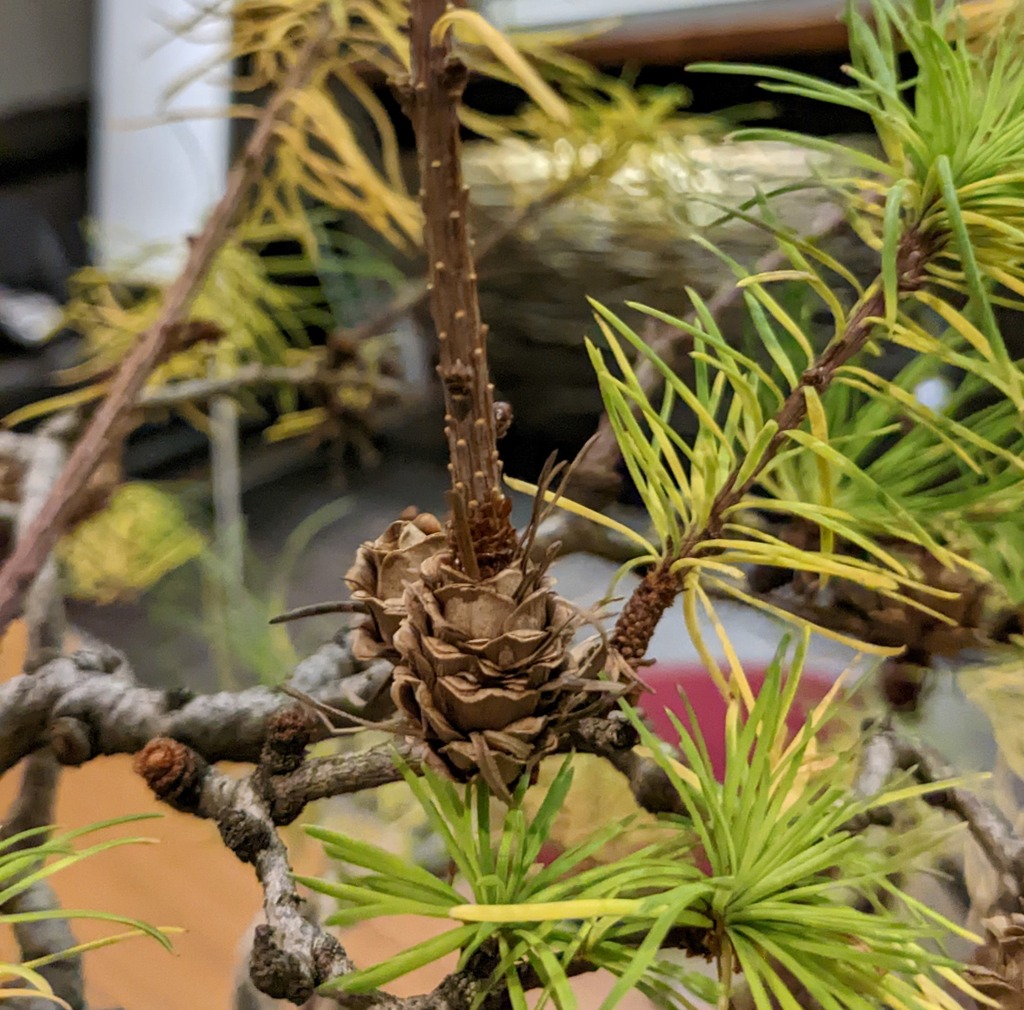
Below is a picture of some interesting behaviour I’d never seen before – this Japanese larch belonging to a member of my bonsai club produced buds and new stems right through the middle of its cones. Pollen and seed cones on larch are terminal organs growing only on short shootsref – which means they aren’t supposed to extend. But Larix is known to be able to change the type of shoot from short to long if damaged (which may have been triggered by the hard pruning it received).ref So in this case what had been a short shoot destined to eventually fall off, instead turned into a long shoot.
So what does it all mean? From a bonsai point of view, the first thing is to work out if a tree has shoot differentiation. If it is deciduous, it will, and if it is a gymnosperm, it still may even if evergreen – gymnosperms which have shoot differentiation include Pseudolarix, Taxodium, Sequoia, Cedrus, Larix, Ginkgo, Pinus & Metasequoia. Understanding the difference between short and long shoots will allow you to understand where foliage will ramify, and where the long-term structure of the tree can come from. On trees which don’t have shoot differentiation, any stem which has a vegetative bud can be used to develop the shape of the tree.

So now we know that long and short shoots exist in many trees, let’s turn to how those shoots form. According to Thomas (2018) , there are three options.

Option 1 is ‘fixed’ or ‘determinate’ growth. These trees preform every part of the shoot in the bud, so they extend very quickly (a few weeks) and then stop. If they are young (less than 10-15 years old) and have the right conditions, they may do this a second time around the start of August (in the Northern hemisphere), this is known as Lammas growth. The shoots from these trees developed based on the conditions at the end of *last year’s* growing season.

Option 2 is ‘free’ or ‘indeterminate’ growth. These trees have only some preformed leaves. Once extended the shoot will continue to produce other leaves from scratch in a continuous fashion. Often these are found in the tropics or warmer climes (my potted Eucalyptus never seem to stop producing leaves even during winter).

Option 3 is ‘rhythmic’ growth. These trees extend in recurrent flushes, with multiple cycles of growth and bud formation during the season.

Outside of the tropics, towards the end of the growing season all trees will stop shoot and leaf growth according to their phenology, in order to complete the formation of buds for next year. If conditions are not good, these buds will be fewer and contain fewer leaves. To see a list of which trees have which types of growth see the Growth Types Table. The relevance to bonsai is that trees with determinate growth are only going to give you one or at most two cracks of the whip in a given season. Those with indeterminate growth might be easier to develop since they will keep extending as long as the conditions are suitable.

Interestingly one study on lammas growth (second flushing) found that 73% of this occurred from lateral buds. We’d obviously love to have this in bonsai as it helps ramification within the same growth season.ref This articleref summarising lammas growth factors says that it can be encouraged by warmer temperatures (Pinus densiflora), extra watering (Pinus sylvestris), nitrogen fertiliser (Pinus sylvestris, Pseudotsuga menziesii) and applying a blackout treatment for less than 2 weeks early in the summer (Picea abies). So from a bonsai perspective see if you can encourage second flushing to generate those lateral buds.

And finally we come to internodes – these are the length of the shoot between each successive leaf. In general bonsai afficionados are looking for short internodes so they can achieve compact, dense foliage. The factors which affect internode length when a tree grows are the same as for any other type of growth – genetics, plant growth regulators and availability of nutrients. Shorter internodes can be achieved by (1) shoot pruning, (2) thigmomorphogenesis and (3) starvation.

If you allow a shoot to extend naturally (and it has no competing stressors), it will prioritise resources into growing as long as it can and the growing tip will suppress the growth of any lateral shoots below it – because the driving force for a tree is to grow large and establish the biggest exposure it can to sunlight. An angiosperm will grow a series of internodes with leaves at each point. What I have observed from looking in my garden is that the internode length on an angiosperm tends to start small (or in some cases leaves are grown directly at the node as well), then increase in size, then reduce again.

To get the smallest internodes, you should prune off the growing tip once the first pair of leaves and the first internode has grown. If leaves have grown at the node, you could remove the shoot altogether (there will be no internode in this case). New shoots will grow from buds in the leaf axils, and if you keep doing this, you will always retain the short first internode and increased ramification.

You could also make use of thigmomorphogenesis which is “the response of plants to mechanically induced flexing, including the brushing or movement of animals against plants, or the flexing of above ground portions of a plant by wind, ice, or snow loading”ref According to this articleref, “the most consistent thigmomorphogenetic effects are a reduction in shoot elongation and an increase in radial growth in response to a flexing stimulus resulting in a plant of shorter stature and thicker, stiffer stem.” i.e shorter internodes and thicker stems.

Thigmomorphogensis is thought to be triggered by plant growth regulators or other substances within the plant signalling when it has been touchedref. To trigger thigmomorphogenesis in your tree, you could expose it to wind while the buds are developing, rub the internodes for 10s daily (seriously, this is what they did in the original studyref which identified the phenomenon), touch the leaves regularly or manhandle the growing shoots.

Another way that bonsai enthusiasts encourage small internodes is by starving the tree. Fertiliser helps the tree grow and this will lead to longer internodes and larger leaves. Holding back fertiliser may result in the desired effect – but also could impact the tree’s health negatively – so it is a balancing act.

So there you have it – shoots turn out to be surprisingly interesting. For your bonsai, try to work out if your tree is shoot differentiated, and if it is, aim to use long shoots for structure and short shoots for foliage ramification. If it has determinate shoot growth, you need to work with the one or two shoot extensions that you get per year, and to get that second flush with lots of lateral buds try using one of the techniques above (warmer temperatures, extra watering, nitrogen fertiliser). Finally keep internodes small with judicious pruning, foliage fondling and holding back fertiliser.

What is a Tree?

Roland Ennos gives an excellent explanation of the evolution of trees and their differences in his book Trees: A complete guide to their biology and structure and most of the below comes from Chapter 1 of his book. But the simple version comes from Colin Tudge: “‘Tree’ is not a distinct category, like ‘dog’ or ‘horse’. It is just a way of being a plant.”

A botanical definition for ‘tree’ is ‘any plant with a self-supporting, perennial (living for more than one year) woody stem’. The main way that trees become self-supporting is through a process known as secondary growth, where a layer of stem cells around the outside of the stem divides to produce xylem tissue on the inside and phloem tissue on the outside. The xylem transports water but also gives structural strength to the tree, and this annual growth is responsible for trunk thickening.

From a biological taxonomy point of view, the tree form exists in several classes and families within the Tracheophyta phyllum, which is the phyllum within the Plantae kingdom containing all vascular plants (that is, plants with conducting vessels for water and phloem). You can read more about this in: The kingdom Plantae and where trees fit in.

The angiosperms (flowering plants), as the latest evolving and most successful class have some differences from other trees which is relevant to bonsai-ists. These differences include:

  • Angiosperms have specialised water transport vessels in their xylem which allows them to move more water more quickly than non-angiosperms (leaving these species more subject to embolisms and less drought-proof).
  • Their leaves are a lot more variable in terms of size and shape, and are often deciduous (there are a few deciduous species in non-angiosperm families but these are a minority – including Ginkgo, Dawn redwood and Swamp cypress). Deciduousness means that these trees do not need to create frostproof leaves, so they can take different, more productive forms (such as large leaves with high photosynthetic capability).
  • Even so, leaves of evergreeen angiosperms are still more productive than those of their counterparts in other families – possibly because their more efficient water transport allows for more transpiration and so larger leaves with more stomata (hence more photosynthesis).ref
  • Angiosperms produce ‘tension wood’ in response to gravity – if they detect a displaced stem they react by creating wood on the upper side of the stem to pull it back up again. Conifers do the opposite – they produce compression wood on the underside of a stem to change its position.ref

The next question you might want to ask is what is a bonsai?

ginkgo bud

Buds

Buds are the “small lateral or terminal protuberance on the stem of a vascular plant that may develop into a flower, leaf, or shoot.”ref Buds are responsible for primary growth, and are created by meristem tissue (a meristem is an area of stem cells which differentiates into different types of cells).

If you look inside a developing bud, you can see the starting points of the different cells which will arise – they can be vegetative buds (shoots & leaves) or reproductive buds (flowers in angiosperms or strobilus/cones in gymnosperms). Below is an image of a Jack Pine terminal bud which has many lateral vegetative buds on the sides.

https://botweb.uwsp.edu/anatomy/images/budanatomy/pages_c/anat0999new.htm

When shaping your bonsai, you want to know where buds may appear, so that you can encourage the direction of growth and shape you desire. Predicting bud location is relatively easy in angiosperms, which follow a relatively reliable pattern in their growth. Bud growth is more unpredictable in gymnosperms, but many of the following guiding principles remain.

Firstly, there are different bud positions:

  • The terminal bud is at the end of a stem or branch and this is the growing tip which makes the plant grow larger.
  • Axillary buds develop along the stem during the annual growing season according to the architecture of the tree (see below for more); within this, preventitious buds are axillary buds which are dormant and then develop in a later season.
  • Adventitious or epicormic buds are buds which do not develop according to the repeating architectural pattern – they arise spontaneously from previously non-meristematic (growing) tissue which can be anywhere on the tree. They are unpredictable as described in this post.

Below are some examples of angiosperm buds. The terminal bud is on the end of the shoot, this comes from the shoot apical meristem (SAM). Then there are axillary/lateral buds which occur along the shoot – in angiosperms these develop in the leaf axils (a position adjacent to where the leaf is attached).

https://ohioplants.org/twiginfo/

Bud behaviour depends on a tree’s architecture, which is genetically determined – that is, it will be very similar for trees of the same species, albeit also affected by the environment. There is a lot of research out there about tree architectures, much of it pioneered by Halle & Olderman in the 1970s, there is even a mathematical model which can be used to represent the architecture of a given speciesref. As explained in this excellent articleref, “regular development of each plant represents the growth of repeating units – ‘phytomers’…a typical phytomer consists of a node, a subtending internode, a leaf developing at the node sites and an axillary bud (also called lateral buds) located at the base of the leaf”.

Each type represents a pattern consisting of a shoot with one or more leaves in the same arrangement. In some trees growth is repeated in a sustained way throughout the growing season (a single flush of leaves), whilst conditions are right. In others there are alternating growing and resting stages (multiple flushes of leaves). During the resting stage, new leaves and shoots are being created inside the budref. I’ve copied some of the main architectural models into this post: Tree Architectural Models

An important part of the phytomer pattern is the leaf arrangement, known as the phyllotaxis. Leaves can grow singly at one position on a stem, or they can grow in whorls where two or more leaves appear at the same position arrange around the stem. When leaves grow singly they spiral around the shoot to optimise their light capture – apparently using the ‘golden angle’ of 137.5o ref.

The leaf arrangement on your tree is important because each leaf axil (the base of the leaf) should be the location of an axillary bud (although in gymnosperms these can be missing). These are key to bonsai because they become new shoots (with leaves or flowers). They develop in the position just above where a leaf used to be; when it falls off, a scar is left and a bud generates above the scar.ref In fact what is happening is a continuous bud genesis, so when you have a bud about to burst, it already has embryonic buds developing at its base – this is why buds look like they form at the leaf axil (in fact they formed on the previous bud). Your new branches and leaves will generate from these positions, and dormant buds may be located here. Read more about buds in angiosperms here, and in gymnosperms here.

The growth of an axillary bud (and its embryonic buds) can be suppressed by its neighbours – this is how ‘apical dominance’ works. It used to be thought that in apical dominance, the shoot closest to the sun emitted hormones which suppress the growth of buds lower down the plant, ensuring that it gets the most resources. This research group at Cambridge University study the development of axillary shoots and their research says “shoot apical meristems compete for common auxin transport paths to the root. High auxin in the main stem, exported from already active meristems, prevents the activation of further meristems”ref. This results in axillary buds going dormant and becoming ‘preventitious’ buds, but they are still available to grow later if conditions change. According to this article, apical dominance in trees only works on buds in the current year of growth due to the slow movement of the hormone auxin through the treeref – meaning that current year buds on a branch are suppressed by the terminal bud on that branch and not by the main leader. HOWEVER, it has recently been found that auxin does not move fast enough to have this effect, and instead it is driven by sugar flows to the apical meristem.ref The effect of apical dominance remains, however it is now thought that sugar flow drives this and not auxin directly.

Encouraging axillary bud growth is a way of increasing ramification on a bonsai, as it can create multiple shoots instead of just the terminal buds. If the terminal buds are removed, axillary buds get the chance to grow, often more than one.

Application of exogenous cytokinins (benzyladenine) has also been shown to increase bud initiationref (see my post on ramification of Branches and Foliage for some substances containing benzyladenine).

Equally, looking at how the leaves are arranged, you can work out where new shoots will arise from existing stems. By removing the buds or shoots not meeting your design, you can encourage shoots to grow in the direction and position that you want. But it’s not enough to know about bud position, you also need to know what kind of bud is present – a vegetative or a reproductive bud, and you need to know the difference between short and long shoots – more here.

Thickening the Trunk

The first quality of a good bonsai is a thick trunk with movement and mature bark. So what actually contributes to the growth of a tree trunk?

Two processes are involved. The first is the creation of new sapwood. Sapwood is the living wood towards the outside of a trunk which conducts water (Ennos, 2016). Sapwood formed in spring is called ‘earlywood’ and is optimized for water & nutrient transport to help the tree with its growth spurt. Latewood is designed for structural support and carbon storage.

Water and nutrients are conducted from the roots through xylem vessels. The mechanism by which they work is explained in xylem but for the purpose of this section it’s important to understand that the reason why trees add new xylem vessels is because as it adds biomass – new branches and leaves – more water is required. So – the more biomass is added in a given growing period – the more water is needed – the more xylem vessels are added to the trunk. Xylem vessels also become non-functional for reasons explained in embolisms, so trees need to replace them as well as adding to them due to new growth. 

New sapwood (with xylem vessels) is added around the previous sapwood, encircling the tree. How much of the girth of a tree increases each year is determined by the tree’s food supply (Trouet, 2020); this is a combination of the amount of rainfall and the energy from the sun during that year.

This studyref found that “low precipitation at the start or during the growing season was found to be a significant factor limiting radial growth” for a range of urban trees in the UK. According to Trouet, “alternating wet & dry years create wide and narrow rings respectively.” So low water levels lead to small rings and high water levels lead to large ones. The earlywood creates a larger ring than the latewood, since the xylem vessels are larger in earlywood (for water transport) and smaller in latewood (for structural strength) (Ennos, 2016).

What this means for bonsai is that watering your tree well is important while developing its trunk, whilst ensuring you have a well-drained growing medium to avoid creating anoxic conditions (lacking oxygen). If your medium is well-drained and you water thoroughly throughout the tree’s growing season (but particularly during earlywood development), you’ll boost your tree’s girth by creating wide ‘good times’ sapwood rings.

The other factor mentioned is energy from the sun. Energy from the sun is used by the tree in photosynthesis, which converts energy into a form that the tree can use to respire and grow. If there is more sun, more energy is available and the tree is able to create more xylem, buds, leaves and biomass. This isn’t a straightforward linear relationship however, as photosynthesis reaches a saturation point based on a number of limiting factors (more in the post about photosynthesis).

The key point here is that reducing the ability of the tree to capture and convert energy will affect its growth. If you reduce the foliage on your tree or cut it back in spring, you reduce its biomass, it can’t generate as much energy, and doesn’t need as much water, so doesn’t add as many xylem vessels as it would have nor as wide a ring of sapwood. This reduces the trunk thickening you can achieve in a given time period. 

It’s worth noting that the roots of a tree need to be capable of delivering the amount of water that its foliage and branches require. Optimising trunk thickness requires a dense canopy of leaves and branches, matched by roots capable of delivering the amount of water that they need. This is why many bonsai enthusiasts will start a tree off in the ground or in a large pot, allowing growth to drive the trunk size until it’s at the level required.

Attempting to restrict the roots and size of the tree too early (e.g. by putting it in a bonsai pot) will restrict trunk growth by reducing the water available to the tree and reducing the energy it can create by reducing its foliage.

Like people, trees are genetically programmed to have different maximum heights and lifespans. Some trees are slow-growing (such as Yew) and some are fast (such as Eucalyptus) so to an extent the amount of trunk thickening that is possible also depends on the species of tree.

Trees grow most vigorously when they are free from environmental stressors – such as drought, extreme cold, loss of leaves due to high winds, attack by insects or animals.  A stressed tree will grow a narrow ring. BUT stress in the form of wind can foster positive qualities in a trunk. Ennos (2016) says that trees exposed to high winds without a prevailing wind direction grow shorter, with thicker trunks & roots, and adjust their wood cells to spiral around the tree creating a twisting effect. It’s not just the trunk that is affected – apparently this results in smaller leaves and shoots as well. Get your bonsai a wind tunnel!

Another way to thicken a trunk is to grow a ground-level branch, as layers of xylem will be added around this branch as well as the truck, or to have a multi-stem tree, which operates on the same principle. You want to avoid having one too much above the ground though, as it might cause the dreaded reverse taper.

I mentioned two processes involved in secondary thickening – the second process is the effect of an increasing bark layer. In most cases this will be dwarfed by sapwood increases but nevertheless biomass is added as bark via the cork cambium, another secondary meristem on trees. Some trees which retain multiple periderms (layers of cork with their meristems) can develop very thick bark which does contribute to the overall trunk girth as well.

How big should a bonsai trunk be?

It’s a how-long-is-a-piece-of-string question because the trunk on a bonsai doesn’t exist in isolation, it exists relative to the foliage, nebari and pot. Because trees undergo secondary thickening however, their trunks expand with every year. So, older trees have thicker trunks.

For another post I found this data below. It shows mass rather than volume, but you can see that as trees get older and bigger, their mass skews to the trunk, which ends up being 80%+ of the total mass of the tree. Whereas at the beginning of the tree’s life, on the left hand side of the chart, the leaf mass exceeds the stem mass.

https://nph.onlinelibrary.wiley.com/doi/full/10.1111/j.1469-8137.2011.03952.x

So in general if we want to emulate older trees, our bonsai needs to be weighted towards a fat trunk (and main branches). Note also that the root mass doesn’t go below 20% – the main contribution to mass in a root are the big structural roots which are largest within a metre or so of the trunk. So this gives an indication of how big a nebari should be.

But as mentioned above the trunk exists relative to the canopy so what do we know about the ratio between the two? One measure which is used in forestry is the live crown ratio which is used as an indicator of tree health. The live crown ratio is the vertical length of the foliage as a percentage of the total tree height.ref Some studies have measured crown ratios for different species (usually in managed forests):

  • A stand of coast redwoods: between 30%-50%ref
  • Douglas Fir: in the 80% range for 20y old trees, down to the 40% for 40y old trees and up to 60% range for 450y old trees
  • Turkey oak: between 20%-50%

Also interesting is the crown radius to trunk diameter. A study measured this for 22 different species including both angiosperms and gymnosperms and came up with equations that represent the ‘allometric types’ for each species – that is an equation that describes how a tree’s dimensions change over time.ref For example for common beech (Fagus sylvatica) they found (see table 5) that the following equation could be used to calculate the crown radius given a particular trunk diameter:

ln(crown radius) = 0.0111 + 0.4710 x ln(trunk diameter) ; (note crown radius is in m and trunk diameter in cm)

if we have, for example, a 1m wide trunk, you could calculate the crown radius as follows: 0.0111 + 0.4710 x ln(100) = 2.180 so crown radius = e2.180 = 8.85m – this actually then gives a crown diameter of 2 x 8.85 = 17.8m. So an old beech which has achieved a 1m wide trunk could have a nearly 18m crown diameter – which means the trunk is about 5.5% of the width of the crown.

Because I love a bit of excel, I took the data for the rest of the species to work out the trunk/crown diameter ratio for each of them based on a 1m trunk – and here is the answer:

So for most species a 1m trunk will be between 4% and 10% of the width of the canopy. I couldn’t resist looking up Auracaria cunninghamii to see why it was different – it looks like the canopy habit is quite narrow which increases the trunk/canopy ratio#.

If you have Douglas fir, this study found that “the vertical distribution of branch volume shifted toward the upper-crown with increasing tree age”ref The mechanisms at work include self-pruning, branches dying and falling off and then adventitious branches growing in the spaces. As they included a picture you can see it makes quite an obvious difference to the look of the tree.

https://archives.evergreen.edu/webpages/projects/files/studycenter/ishii.pdf

That’s just one species though – the shape of old trees is going to be to a certain extent genetically determined so different species will have a different mature look in terms of their shape and branch distribution.

Conventional bonsai wisdom says a tree needs to have good taper in order to look old. This means it is thicker at the bottom than at the top. But tree-ring researcher and dendrologist Valerie Trouet in her book Tree Story says otherwise. She says “once height growth has stopped in an older tree, then the upper part of the stem will start to catch up, it’s girth increasing year after year, and the stem will gradually take on a more columnar, rather than tapered, look….the tree’s limbs also continue to thicken; branches and roots of old trees often are quite sizable.”

What we are trying to achieve with bonsai is small trees which look like mature, large ones in nature. So the size of the trunk, whether it has taper or not, needs to be in proportion with the canopy and the roots, and the branches should start anywhere from the 20% to the 50/60% of the total tree height mark and be in proportion to the trunk as in the table above.

There are more attributes which make a tree look old, to learn more check out this post: Old Trees.