Category Archives: How Trees Grow

Photosynthesis

Another epic topic which has occupied scientists for the best part of 400 years, the equation for photosynthesis itself was not understood until the 1930s.ref

Photosynthesis is the process of turning energy from sunlight into chemical energy, a process which famously is performed by plants, specifically by plant cells containing ‘chloroplasts’. Chloroplasts contain a substance called chlorophyll. Chlorophyll is often described as a ‘pigment’ – but this makes it sound like its only role is to colour things green! Which of course it isn’t – being green is just a result of its real function which is to absorb sunlight of a certain spectrum. Chlorophyll absorbs visible light in two regions, a blue band at around 430 nanometers and a red band around 680 – according to Vogel. Other sources state the bands are 680 nm and 700 nmref. Everything else is reflected, which looks green. Chloroplasts are believed to have originally been cyanobacteria which were incorporated into plant cells to provide photosynthetic capability (Lane, 2005). To see where chloroplasts and chlorophyll are present within a leaf, check out this post on leaf structure.

The sequence of reactions which happen during photosynthesis are known as the Calvin-Benson-Bassham cycle, after the scientists who discovered it. The simplified equation describing photosynthesis is as follows:
6CO2 + 6H2O –light energy–> C6H12O6 + 6O2.

This suggests that photosynthesis is the exact opposite of respiration, creating glucose instead of consuming it. But actually this equation is incorrect as photosynthesis does not create glucose. The Calvin et al cycle produces a molecule called G3P which is a 3 carbon sugar which can be used to create other molecules. Anyway, that’s probably not super-relevant for bonsai! The main insight from the equation above is that light energy is needed for plant survival and growth – this is why trees do not like being inside unless they have a suitable artificial light source.

Another point to note is that plant cells, like all living cells, respire. Plant cell respiration is like animal respiration, that is, cells consume oxygen and glucose to produce energy, while emitting carbon dioxide and water. Cells use respiration to generate the energy they need for metabolism (basically, keeping the cell alive and functioning). All cells in a tree respire, including the leaves, roots and stems, 24 hours a day. This means trees offset some of their photosynthesis by respiring – in particular at night when no photosynthesis occurs.

On balance, leaves produce a lot more sugars and oxygen through photosynthesis than they use during respiration – and this provides the energy they need to maintain themselves and grow. In fact the point at which they *don’t* produce more than they use through respiration is as low as 1% of full sunlight (Vogel). Note that this low level can be reached if a leaf is entirely shaded by 2 other leaves, since the typical light transmission through a leaf is only 5%.

Another interesting fact about photosynthesis is that leaves can only use about 20% of full sunlight before the photosynthetic system saturates (Vogel). This number actually varies depending on the species and leaf type. So leaves below the top layer (likely to be ‘shade leaves’ described in this post: Leaves) can still get enough light from partial exposure, if they are slightly shaded or lit for only part of the day, to saturate and max out their photosynthetic capability. The majority (99%) of the energy absorbed is used to maintain the leaf itself, so only 1% is released for growth.

But – back to the photosynthesis equation – which is an extremely simplified version of what is actually happening. Photosynthesis requires 150 discrete steps involving a similar number of genesref. A good reference is this Nature article.

Photosynthesis takes place in two stages. First the ‘light dependent’ reactions happen. Light energizes electrons within the chlorophyll, and these electrons are harnessed to produce ATP (adenosine triphosphate) and NADPH (nicotinamide adenine dinucleotide phosphate) which are molecules used by cells for energy and as an electron source. The chlorophyll replaces its lost electrons by taking some from water – effectively they ‘burn’ or oxidise water, leaving the oxygen behind as a waste product (Al-Khalili).

After this the ‘light independent’ reactions happen. These are facilitated (sped up) by an enzyme known as RuBisCO. Using the energy sources created in the first step (ATP and NADPH), RuBisCO ‘bolts’ together the hydrogen from the water, and the carbon and oxygens atom from the carbon dioxide, along with phosphorus, to make the 3 carbon sugar glyceraldehyde-3-phosphate (C3H7O7P) (Lane, 2005). This is known as carbon fixation.

In reality there is also a third stage where the ingredients for the cycle are regenerated so that it can continue running.

The full equation (the Calvin-Benson-Bassham cycle) – is:
3 CO2 + 6 NADPH + 6 H+ + 9 ATP + 5 H2O → C3H7O7P + 6 NADP+ + 9 ADP + 8 Pi   
(Pi = inorganic phosphate, C3H7O7P = glyceraldehyde-3-phosphate or G3P)

Sorry for geeking out for a minute there!

An important point is that photosynthesis doesn’t just go up with increasing sunlight, it has a set of limiting factors which were described by Blackman in 1905 in his articleref “Optima and Limiting Factors”. He said “When a process is conditioned as to its rapidity by a number of separate factors, the rate of the process is limited by the pace of the slowest”. The limiting factors he described for photosynthesis included light intensity, carbon dioxide and water availability, the amount of chlorophyll and the temperature in the chloroplast.

The amount of sun needed to max out photosynthesis from a light intensity point of view is not as high as you would imagine. Vogel says a leaf “absorbs about 1000W per square metre from an overhead sun shining through a clear sky” and photosynthesis only consumes 5% of this – 50W per square metre. Obviously this is going to vary depending on the species and whether a leaf is a sun leaf or a shade leaf.

But what does it mean for bonsai? Well – you might have spotted some other elements in the photosynthesis equation. NADPH (formula C21H29N7O17P3) contains nitrogen and phosphorus, as does ATP (formula C10H16N5O13P3). RuBisCO relies on a magnesium ion to perform its role as a catalyst. There are a bunch of other enzymes and co-factors which are required to support photosynthetic reactions as well – which explains why certain nutrients (including Nitrogen, Phosphorus, Magnesium, Potassium, Chlorine, Copper, Manganese and Zinc) are critical for trees in varying amounts – more here: Nutrients for Trees.

And if you’re concerned about whether your trees have enough light for photosynthesis, you can see exactly how much energy is arriving on your outside bonsai at this site. Find your location and download the PDF report and you’ll see the irradiation levels – which can be useful in understanding how your bonsai trees will fare. As an example, the max in my location is 328Wh/m2 in April which explains why the olive trees in London are so unhappy looking – if you look at irradiance in Greece, where they thrive, it barely ever goes under 328Wh/m2 even in winter! Trees in Greece receive nearly double the amount of irradiance than those in South West London.

One final point of interest with admittedly little relevance to bonsai – some plants (nineteen different plant families, independently of each other) evolved an improved photosynthetic process which is known as C4 photosynthesis. This concentrates CO2 nearer to the RuBisCO enzyme, reducing its error rate. Unfortunately most trees use C3 photosynthesis with its associated inefficiency – other than Euphorbia, which are apparently “exceptional in how they have circumvented every potential barrier to the rare C4 tree lifeform”ref.

Growth Types Table

Fixed Growth (determinate)
(leaves formed inside the bud before opening)
Free Growth (indeterminate)
(leaves and buds continue forming throughout season)
Rhythmic Growth (a bit of both)
Ash
Beech
Hornbeam
Oak
Hickory
Walnut
Horse chestnut
Pine
Spruce
Ginkgo short shoots


Elm
Lime/linden
Cherry
Birch
Poplar
Willow
Sweet gum/ liquidambar
Alder
Apple
Larch
Juniper
Western Red Cedar
Coastal Redwood
Ginkgo long shoots
Maple
Loblolly pine
Shortleaf pine
Monterey pine
Caribbean pine
Cocoa
Rubber tree
Avocado
Mango
Tea
Lychee
Citrus
Olive
Pinus radiata
From Thomas (2018) and RNETR

Plant Growth Regulators (or Phytohormones)

You’ve probably heard of rooting hormone powder, or auxin, or gibberellins – these are all ‘Plant Growth Regulators’. Plant Growth Regulators used to be known as ‘phytohormones’ which means plant hormones. This has been quite a contentious topic among plant biologists.

A hormone in an animal is a chemical messenger, a substance which acts as a signalling or control molecule to cause an action to take place. “Hormones carry out their functions by evoking responses from specific organs or tissues that are adapted to react to minute quantities of them”ref. In animals, hormones are produced at a specific site (a gland, like the pancreas), work at low concentrations, and have a predictable dose-response. That is, an increase in hormone will result in the more of the related action (eg. more insulin leads to more sugar being taken up by the liver).

There *are* substances synthesised by plants which are involved in regulating growth – plant growth regulators – but they don’t work in the same way as animal hormones. It’s said that the assumption that they did sidetracked plant researchers for decades.ref Plant ‘hormones’ are synthesised in multiple sites in a plant (and potentially in every cellref), have multiple actions on different cells (they don’t act on just one organ or tissue), don’t exhibit predictable dose-response behaviour like animal hormones and are involved in significant interactions or feedback loops with each other.ref

What this means is that it’s quite hard to unpick what they do and how they work. The roles and mechanisms of plant growth regulators are still very much current research topics, as can be seen at two of the research groups at Cambridge University’s Sainsbury labref1,ref2 Some of the early theories about them were comprehensively demolished in a seminal article by Anthony Trewavasref (in particular the theory of auxin-derived apical dominance which was later proven wrong as explained below).

We now know that plant growth regulators act in concert with genes and the proteins they express, and not as an independently acting substance (one of the genes involved in cytokinin synthesis is known as LONELY GUY…).

So what are the plant growth regulators, where and how are they made? There are nine main plant growth regulators you may come across in your reading:

  1. Auxinref – classically called ‘the growth hormone’ and a signal for division, expansion, and differentiation throughout the plant life cycle – involved in root formation, branching, the tropic responses, fruit development, shoot meristem function, the development of cotyledons and senescence. The most common form is Indole-3-acetic acid (IAA). Auxin acts in a ‘ying-yang’ relationship with cytokinin (see below)ref as well as with gibberellins. More about auxin below.
  2. Cytokinins (CK)ref1 ref2 – involved in cell division, shoot initiation and growth (including maintaining the stem cell niche), nutritional signaling, root proliferation, phyllotaxis, vascular bundles, leaf senescence, branching and nodulation, seed germination, nutrient uptake, and biotic and abiotic stress responses. 6-BAP or 6-Benzylaminopurine is a synthetic cytokinin which is used in micropropagation and agriculture. Coconut water (not milk) has been found to be a natural source of cytokinins.ref
  3. Brassinosteroidsref – involved in a wide spectrum of physiological effects, including promotion of cell elongation and division, enhancement of tracheary element differentiation, retardation of abscission, enhancement of gravitropic-induced bending, promotion of ethylene biosynthesis, and enhancement of stress resistance.
  4. Gibberellins (GA)ref – involved in multiple processes including seed germination, stem elongation, leaf expansion and flower and fruit development.
  5. Strigolactones (SL)ref – induce hyphal branching of arbuscular mycorrhizal fungi and are shoot branching inhibitors.
  6. Abscisic Acid (ABA)ref – involved in the induction and maintenance of seed dormancy, stomatal closure, and response to biotic and abiotic stresses.
  7. Jasmonates (JA)ref – shown to be inhibitors of growth but also involved in development of flowers and defense responses against herbivores and fungal pathogens
  8. Salicylic Acid (SA)ref – associated with disease resistance
  9. Ethyleneref – multiple effects on plant development including leaf and flower senescence, fruit ripening, leaf abscission, and root hair growth.

Slightly maddeningly none of these substances do just one thing – they’re all involved throughout the plant!

So how and where they are made in a plant? This isn’t simple either. In fact local biosynthesis is thought to be critical for plants, whereby plant growth regulators are made at the site where they are needed. For example both auxin and cytokinin are synthesised in leaves *and* in rootsref, and can be made by chloroplasts and mitochondria, organelles which occur throughout the plant.ref Chloroplasts can make precursors to auxin, abscisic acid, jasmonates and salicylic acid.ref

Even though plant growth regulators don’t act in a predictable dose-response way like animal hormones, they still have a role in shaping plant growth in tissues which are sensitised to respond to them. Theoretically by understanding these responses we can manipulate a tree’s growth. And this is what they do in plant tissue culture (more on that below).

You may have heard the theory of auxin-controlled ‘apical dominance’, which holds that auxin produced by leaves at the apex inhibits lateral buds. This theory was strongly criticised by Trewavas in 1981: “The only hypothesis of apical dominance which has retained some measure of support is the nutritional one. A number of plants placed under conditions of reduced nutritional status adopt a growth pattern of strict apical dominance.” His point of view was further supported by a 2014 study which found that “sugar demand, not auxin, is the initial regulator of apical dominance”.ref The researchers found that after removal of the shoot tip, sugars were rapidly redistributed over large distances and accumulated in axillary buds within a timeframe that correlated with those buds releasing. But auxin didn’t travel fast enough to be responsible for bud release. So basically they found that apical dominance arises because the main shoot is greedy for sugars, and due to its position at the end of the vascular system it can prevent lateral buds from taking the sugars needed to release and grow.

Auxin does play some role though, and the theory is that its role related to the fact that it’s the only plant growth regulator which displays polar transport. That is – it moves from the apex to the base of the plant, via the phloem, and can travel the entire length of the plant, ending up in the roots. This gives auxin a special role related to the spatial aspects of growth, and auxin ‘maxima’ (locations where auxin accumulates) are sites where new buds, flowers or lateral roots emerge. In fact, auxin and cytokinin work in concert throughout the plant, from shoots to roots, with apparently opposite effects in each location “like yin and yang”.ref

An excellent reference point for this subject is the world of plant tissue culturing. This is where small pieces of plant tissue are sterilised and cultured in a medium containing plant growth regulators, which cause the tissue to grow into a ‘plantlet’ (sometimes in a test tube, if the source material is small). Further steps multiply the plantlet into several plantlets, which are then encouraged to create roots, multiplied again and/or planted out as seedlings to harden off. This process is used for industrial plant cloning where large numbers are required, and in the aquarium trade to avoid contamination with snails and other microbes (see Tropica’s website).

In plant tissue culturing, plant growth regulators are used to induce the relevant growth stage, which ones work for each species in which stage is documented in the ‘protocol’ for that species. In all cases specific ratios of cytokinin:auxin (and sometimes gibberellins) lead to different developmental stages – shoot growth, lateral shoot growth and root growth.ref1, ref2 To give you a bonsai-oriented example, one study determined a protocol for the micropropagation of Prunus Mumeref. They were able to multiply fresh prunus mume shoots in a petri dish using a 4:1 ratio of cytokinins to auxins, and then root them using auxin.

So – apologies for the rather long read, it is quite a complicated subject! What can we take from all this for our bonsai practice? Firstly we can stop the brain-bending trying to understand how auxin controls apical dominance because it doesn’t – access to sugars does this instead.

Also we can use the yin-yang rule – high cytokinin:auxin encourages buds & shoots, and high auxin:cytokinin encourages roots. So I’m going to start adding some auxin rooting gel into my air layers and cuttings. Cuttings have never worked for me in the past so maybe this will be the secret sauce I need. I’m also going to try some cytokinin gel to encourage lateral budding on my trees.

If you are looking for products to give this a try, make sure the product actually contains the plant growth regulator you want. For example, Clonex contain auxin, and some of the orchid budding pastes such as Keiki paste contain Kinetin (a cytokinin). Many other ‘rooting hormones’ or plant hormones products on the market have no ingredient list at all, so avoid those. You can also find these products online in shops dedicated to hydroponics, where cloning and plant tissue culturing is a technique used by practitioners, or in lab supply shops such as microscience or Phillip Harris in the UK. You can even make your own hormone gels following these instructions.

Another trick you can use is that gibberellic acid can be used to break dormancy in seeds, if you really don’t have the patience to wait for natural dormancy to break. Or give coconut water a try, this has been found to have a similar effect in a range of species. For hard coated seeds in particular, usually it’s best to search Google Scholar for a researcher who has experimented with different approaches, since what works is very species-dependent.

Leaves

Rather naively, when setting up this website, I made a note to create a post on the topic of ‘leaves’. Several days of research later it’s clear, there can’t just be one post about leaves! Why? Well, leaves are the reason that complex life on earth exists. Their ability to photosynthesise – to turn energy from the sun into energy that living things can use – is fundamental to our planet. So – there is a lot going on inside a leaf. My starting point for this post is the wonderful book ‘The Life of a Leaf’ by Steven Vogel, and I am going to cover the purpose of leaves, respiration, transpiration, and how leaves deal with environmental challenges like heat, wind and cold. There is a lot more to know about leaves, to read this check out all the other posts tagged with ‘leaves’, or start with leaf structure.

So, what is the purpose of leaves? Simply, they are the energy generating mechanism for plants. Through the process of photosynthesis they use energy from the sun to ‘burn’ water, removing its oxygen atom and bolting the remaining hydrogen onto carbon dioxide to create sugars. These sugars are used to power the life and growth of the plant. And as a side-product, oxygen is created, for animals and humans to breathe. Photosynthesis only happens when a leaf is illuminated by the right kind of light – in nature, this is sunlight during the day. If you want to geek out with more detailed information about how photosynthesis actually works, try this post: photosynthesis

A key concept when it comes to leaves is transpiration. It turns out that up to 97% of the water used by plants is actually evaporated back into the air – a process known as transpiration. The reason for this is because plants need to get CO2 into their leaves in order to supply it to the chloroplasts (organelles which perform photosynthesis) and to make this possible they need to open holes on the leaf surface to allow CO2 molecules to enter – these holes are known as stomata. When the stomata are opened, water naturally evaporates from within the leaf – it is the negative pressure in the xylem caused by this evaporation which pulls the water (and nutrients) up from the roots. What this means for bonsai is that your trees need a lot more water than you might think based on their size – remember up to 97% of it will be evaporated out. But if you water on a sunny day, will you burn the leaves? Find out here.

Did you realise that individual trees have leaves of different shapes and sizes, depending on their position on the tree? Shade leaves are larger, thinner, darker green (containing more chlorophyll) and less lobed, with fewer stomata than sun leaves; conversely sun leaves are smaller, thicker, lighter yellowish green, more lobed, and have more stomata – each leaf is more efficient in their niche of light exposure (Thomas). In her book The Arbonaut, Meg Lowman describes a coachwood tree with each leaf having its own unique formula for success – the lower leaves are long-lived and better structured to harvest low amounts of filtered light, the upper leaves are short-lived “extremely high-powered chlorophyll factories…[which]…produce sugars that keep the entire tree alive, healthy and growing”. And between these, variations to suit the different light conditions. All of this is called ‘photomorphogenesis’, or a “developmental process in plants in which the incident light determines the growth of the plant”ref. One research team even discovered a gene which could force the growth of sun leavesref and resulted in 30% greater photosynthesis.

What this means for bonsai is unclear as it’s not obvious from the research at what scale these differences can manifest. In theory there will be a layer of leaves around the canopy of the bonsai tree which could be sun leaves, and leaves below and within it which could be shade leaves. If it is literally only the sun exposure on a bud which determines what type of leaf is grown, then theoretically these two different leaf types could appear on a bonsai. If so, then removing the top layer of leaves – as is often recommended in bonsai, to ‘let light into the tree’ may not be the best course of action. If the leaves below have grown as shade leaves they may struggle to tolerate their new position in full sun. Anyone noticed sun & shade leaves on their bonsai? Let me know at info@bonsai-science.com.

‘Leaf morphology’ – or the shapes and sizes of leaves – is another rabbit hole you can joyfully enter via Google if you so desire, but to sum things up, leaves have differing physical attributes, each lending the leaves different properties – “leaf traits may reflect the adaptation mechanisms of plants to the environment.”ref

A key measure related to leaves is the ‘specific leaf area’ – the ratio of total leaf area (ie. the total amount of leaf surface) to total leaf dry mass (the total weight of the leaves without water). SLA is used as a measure of the overall health of a plant, as it reflects the efficiency of carbon gain relative to water lossref.

What is observed is that different trees have different strategies for optimising specific leaf area – in addition to photosynthesis mentioned above. Three interrelated attributes include leaf size & shape, leaf venation (how the xylem & phloem ‘veins’ are structured) and stomatal conductance (the number and distribution of stomata on the leaf).ref The model in this article suggests several predictions related to these attributes.

One of these is that a leaf with a larger width to length ratio can support higher carbon production factors, stomatal conductance, and leaf area than a leaf with smaller width to length ratio. So long, narrow leaves are less efficient and have higher ‘stomatal resistance’ – ie. they are less efficient at transporting gas and water vapour in and out of their leaves. This also applies for thick leaves, which have higher stomatal resistance than thin leaves.

That’s not all bad though, because higher stomatal resistance is correlated with smaller xylem, which are more resistant to embolism. These tradeoffs help different trees thrive in different conditions and drive evolutionary adaptation.

The implications of this model that on average narrow leaved species will do better in more arid conditions with less available water, since they transpire more slowly and are less at risk of embolism, and as water becomes more available the broadleaved trees will do better. So conifers may do better on a mountain top, and angiosperms such as beech will do better in the valleys. Translated to bonsai medium, this suggests that a narrow leaved tree (including most conifers) will prefer a more well-drained medium (hence the advice that conifers don’t tend to like getting ‘their feet wet’). Your tropical trees on the other hand – like a Ficus – may be perfectly happy with extremely wet conditions (as long as they don’t become anoxic – ie. so wet they prevent any oxygen from entering).

Leaves have more to contend with than ‘just’ photosynthesising and transpiring – they also have to deal with extremely large temperature variations – “on windless days, ordinary leaves on ordinary trees quite commonly run around 10°C, nearly 20°F, above the air that surrounds them. Under exceptional (exceptionally bad) circumstances they can reach twice that.” So explains Vogel, who then describes in detail the different strategies used by leaves to cool down – starting with evaporation but also including reradiation (radiating heat back into the air) and convection (transferring heat to the air from leaf surfaces and edges). He suggests that smaller, more lobed leaves are better at cooling than large wide leaves – and that large wide leaves avoid horizontal positioning in order to reduce overheating. What this means for bonsai is probably just that the natural leaf shape and positioning of a particular species helps it achieve a temperature balance (as well as photosynthesis) – and also perhaps that highly ramified trees with lots of smaller leaves may have improved temperature regulation (due to improved convection).

Another environmental challenge faced by leaves is freezing temperatures through the winter. One obvious strategy for avoiding these is to be deciduous, but there are plenty of evergreen trees out there and many of them thrive in extremely cold conditions (eg. the boreal forest where snow cover lasts for months and “gymnosperms such as Abies, Larix, Pinus, and Picea dominate”ref). Of the various strategies deployed to avoid damage from freezing (four at least are described in detail by Vogel, as well as in this paperref), the strategy most relevant to bonsai is that the tree generates substances within its cells and organs – such as dissolved sugars, resins and anti-freeze proteins – which reduce the freezing temperature in cells, reduce ice crystal formation and prevent ice crystals from growing within cells. The reason this is relevant is because one of these mechanisms – the creation of anti-freeze proteins – requires a gradual acclimation to the cold. This allows the tree to turn on the genes which produce the anti-freeze proteins, and gives it enough time to accumulate them. So it is a bad idea to move a conifer from a warm/protected area directly into the freezing cold. But if that tree has been in the same place as the seasons change, it will likely have time to build its defences against freezing temperatures.

The final environmental challenge described in fascinating detail by Vogel is the wind. Leaves are adapted to deal with wind so that they can continue to photosynthesise but also not tear, or build up enough resistance to pull the tree over. They do this by bending with the wind into aerodynamic shapes which minimise drag – Vogel’s research includes a great photo illustrating how four different groups of leaves move into cone shapes as the wind increases. One key point for the bonsai enthusiast though – leaves are more resistant to the wind once they have hardened off – if they are new spring leaves they are more prone to being wind damaged.

It’s not just the leaves which contend with all these environmental challenges though, it’s all the microbes on the leaves, in its phyllosphere.

I could write pages and pages more on this fascinating aspect of tree biology but for now I am going to leave it there.

Old Trees

A premise in bonsai is that the best bonsai look like old trees. In my opinion a lot of ‘best’ bonsai look more like fantasy trees from a Studio Ghibli film, and not at all like real trees. I live near Richmond Park in London which has 1300 veteran trees, of which 320 are considered ‘ancient’ (in the third and final stages of their lives)ref and I know that they have reverse taper, weird branching, knots, breaks and all sorts of attributes which bonsai rules would aim to avoid. So what do we know about old trees and how they actually look?

The Woodland Trust Ancient Tree Inventoryref identifies the following general characteristics for ancient trees:

  • Crown that is reduced in size and height
  • Large girth in comparison to other trees of the same species
  • Hollow trunk which may have one or more openings to the outside
  • Stag-headed appearance (dead branches in the crown)
  • Fruit bodies of heart-rot fungi growing on the trunk
  • Cavities on trunk and branches, running sap or pools of water forming in hollows
  • Rougher or more creviced bark
  • An ‘old’ look with lots of character
  • Aerial roots growing down into the decaying trunk

For species-specific attributes check out the Ancient Tree Inventory websiteref which outlines specific attributes for eleven of the most common UK species (Oak, Ash, Beech, Yew, Sweet Chestnut, Alder, Hornbeam, Scot’s Pine, Hawthorn, Field Maple & Lime).

Another studyref outlines some of the expected characteristics of ancient and veteran trees as “a hollowing trunk, holes and cavities, deadwood in the canopy, bark loss and the presence of fungi, invertebrates and other saproxylic organisms.” And citizen submitted recordings of tree measurements across the UK in the same study showed that “ancient trees have larger girths in general than veterans, which in turn are larger than notable trees.”

Trouet in her book Tree Story says that in old trees the top of the tree has ‘caught up’ with the bottom, so the trunk becomes more columnar, whereas a middle-aged tree is more tapered. She also says that branches thicken. This perhaps goes against the bonsai edict of taper above all else.

Another study reports that mature trees have only short shoots – these have smaller leaves and more foliage per shoot that more immature long shoots. Read more in shoots.

So to create a bonsai which looks old, you want it to have a very wide, columnar but hollowing trunk, rough or deeply grooved bark, holes, cavities, dead & broken branches, a compact canopy with deadwood, small leaves on short shoots, and ideally some fungi and a busy community of invertebrates.

Epicormic Buds

There are a few different terms bandied about to describe buds which pop up in unexpected positions on a tree – ‘adventitious’, ‘dormant’, ‘suppressed’ ‘preventitious’ ‘proventitious’. Epicormic growth is actually just growth which forms on old-growth units of the tree – not in the current season’s growth.ref It’s great for bonsai because it helps keep the foliage condensed and well-ramified and allows you to develop branches which are closer to the trunk, to keep the profile compact.

This study proposes standardising on the terms ‘adventitious’ and ‘preventitious’. The key difference between the two types is how they develop –  preventitious buds originate exogenously (due to an external trigger) and descend from a shoot apical meristem, while adventitious buds develop endogenously (due to internal triggers) from previously non-meristematic tissue.ref

A key concept here is that of the meristem which we encountered back in How trees grow. A meristem is an area in a plant containing stem cells – cells which can become any other type of cell. Trees maintain four active meristems which are continuously producing new stem cells as well as differentiated cells used to build the plant (the shoot apical meristem, the vascular cambium, the cork cambium and the root apical meristem). These allow the plant to respond to damage by growing new organs. The different types of epicormic buds arise from epicormic meristems, which are traces of meristematic tissue which are not located in the active portions of the above-ground meristems.

Preventitious buds arise from meristematic traces which are triggered to become full buds and sprout at some point in the future, for example if the tree is wounded or damaged and needs to generate more foliage for photosynthesis. In fact these preventitious meristems may come from axillary buds which aren’t activated during their growth season. Particularly in angiosperms, many more buds are generated than are activated in a growth season, and these buds may stay dormant until needed. Not only that, but mature buds approaching bud burst have tiny buds inside them as well, which become next season’s buds if a bud extends. If it doesn’t extend, there are 2 years of dormant bud tissue available for future activation.ref

Adventitious buds happen when a callus or other wound response creates meristematic tissue which connects to vascular growth (eg. the cambium) and establishes a trace similar to preventitious buds. In the future this trace can become a shoot.

This study identified four different strategies for epicormic bud development – external clustering, isolated buds, detached meristem and epicormic strands.

External clustering is where “trees produce relatively small, persistent axillary buds, which develop into epicormic complexes consisting of numerous buds and shoots”. Even though they are not visible, every year they extend with annual growth creating more meristematic tissue and/or leaf primordia (embyonic leaves), and sometimes shoots as well. These bulges on tree trunks are a familiar sight on many trees  – such as this Linden tree near my house:

The majority of species which are known to be prolific producers of epicormic shoots fall into the external clustering strategy. I often see Oak trees in Richmond Park with rounded protuberances on their trunks – these are epicormic complexes under the bark.

The isolated bud strategy is the “initial production of larger external epicormic buds, mainly high buds, which are less persistent and less likely to form large clusters.” These buds are buried in the bark, or in the case of gymnosperms a meristematic ‘bud base’ is left in the bark.

The detached meristem strategy is also observed in conifers and involves “the maintenance of minimally developed meristems hidden in leaf axils” which require some trigger (like fire) to become active. These meristems are not connected to the vascular system but can connect later when they create buds. Members of the Araucariaceae family have been found to use this strategy, such as the Hoop and Wollemi pines. Ref1, Ref2

The final strategy is epicormic strands “characterized by the presence of extensive meristematic strands within the bark that are capable of producing a continuous series of ephemeral epicormic buds” – this is observed in Eucalyptus.

One key point is to understand why a tree develops epicormic buds into shoots – and the answer to this is that is a response to stress – stressors can include insect defoliation, fire, frost, wind damage, disease, drought , intense competition, low site quality, bole orientation, vascular embolisms and heavy pruning.ref The bad news is that epicormic branches have a reputation for being weaker and not very long-lived. In his book the Wild Trees Richard Preston references epicormic branches on Coast Redwoods, noting that the people who climb these trees avoid putting weight on epicormic branches since they are liable to shear off the tree.

To work out where epicormic buds might appear on a tree, go back and read Buds, as preventitious buds in particular will develop in places where buds could have formed in previous growth period.

Gymnosperm (Conifer) Budding

Gymnosperms relevant for bonsai include ginkgo and the Pinales order (Araucariaceae, Cephalotaxaceae, Cupressaceae, Pinaceae, Phyllocladaceae, Podocarpaceae, Sciadopityaceae & Taxaceae – this is explained in The kingdom Plantae and where trees fit in). Ginkgo is a special case described separately at the end of this post.

So what we’re interested in in bonsai is where lateral buds appear, and in particular whether they can develop adventitiously (or backbud). Angiosperms (flowering plants) are relatively easy to understand in terms of their lateral budding, as many species reliably produce a bud in each leaf axil (the axil is the place on the stem where the leaf is/was connected). In gymnosperms though, this is not as predictable and it’s not the case that each needle contains a bud – at least not in every species and not detectably. And looking at the different foliage forms below, you can see that different bud types must be involved to generate all these different leaf models.

https://cmg.extension.colostate.edu/Gardennotes/134.pdf

Many conifers have a terminal bud at the end of each long shoot/branch surrounded by a number of close lateral buds in what’s called a ‘whorl’. These include pines, spruce, fir, and the Auracaria family. The whorl in the picture is a Scot’s Pine, with a vegetative bud in the middle and reproductive buds around it. This will usually be the apical or strongest bud, receiving the majority of the sugars from photosynthesis.

https://joshfecteau.com/meet-the-pines-scotch-pine/#jp-carousel-8472

When the vegetative bud extends, it is called a ‘candle’ because it is a long thin structure – which looks like a candle. Below you can see a Pinus Thunbergii (Japanese Black Pine). Some candles are extending and some have extended and formed cones from the lateral buds around the main bud. No branching will occur from reproductive buds as they terminate the shoot.

https://www.conifers.org/pi/pi/t/thunbergii02.jpg

Bonsai enthusiasts commonly prune the candles to maintain a short needle length, this has the effect of arresting the needle growth; it is also possible to completely remove the candle, to force bud break at the base of the candle which results in smaller and more buds. In pines there are usually short shoot buds at the base of the candle – these will produce needle clusters in the future but no stem elongation. Breaking or pruning the top of the candle will activate these buds, which is good for ramification. If you want to continue developing the structure of the tree, you need a long shoot with a terminal vegetative bud as this won’t fall off.

As well as the terminal buds, pines sometimes have buds on their lateral shoots, between the needles, as well as internodal buds, which appear along the stem and not just at the end. These usually appear at the axil of the individual leaves on a long shoot/stem (Dörken, 2012).

Other conifers such as those in the Cupressaceae family (Thuja, Juniperus, Cypress) do not have whorls or needles, they have scale-type leaves in ‘branchlets’ (and needle-like leaves when juvenile). You can see below some examples of these which show the lateral buds forming from inside the lateral leaves (the leaves on the sides of the shoots). Since these branchlets squeeze a lot more leaves in, they have more potential for budding than do individually-leaved species such as Abies (fir) and Picea (spruce).

https://craven.ces.ncsu.edu/2022/03/conifers-with-scale-like-leaves-what-makes-a-leaf/

However one key attribute of species in Cupressaceae like these scale-leaved ones above is that just like pines they do still have differentiated short shoots and long shoots (Dörken, 2012). The short shoots are the individual branchlets, which abscise as a unit after a few years (detach from the long shoot and fall off). At the base of this short shoot is another bud waiting to generate a new shoot once the branchlet falls off. So new foliage will come from the leaves on the branchlet while it is active, and then from where the branchlet was connected to the stem when the whole branchlet falls off.

Conifers with individual needles such as firs and spruce, and needle-leaved junipers, have buds at the base of each leaf, but tend to bud towards the end of the most recent growth. Last year we dug up a Christmas tree from our allotment and I pruned the ends of most of the branches because it was too wide to fit into the house. The effect of this has been to stimulate the subordinate branches to bud – but again this has only happened at the ends of the branches (see below). Something about firs & spruces keeps the active budding zone at the end of branches.

As well as understanding the budding pattern, a key question for bonsai afficionados is whether or not a particular tree will backbud. That is, will it be possible to increase ramification and foliage density by encouraging axillary or adventitious buds to form.

Gymnosperms were traditionally believed not to resprout, with research in the past finding that buds are not present in leaf axils of conifers. Despite that, there are quite a few gymnosperms species which do, including the following. Some of these “do not have distinct buds at all; they produce new growth from meristematic tissue hidden under the skin of the twig” (Thomas, 2018) – this is known as an epicormic bud. This may be a false distinction since the meristematic tissue may just be early buds which are not developed enough to be visible.

  • Some Abies (fir)ref including Abies nordmannianaref
  • Araucaria & Agatha species including including Hoop Pineref and Wollemi pine ref1, ref2
  • Cedrus (true cedar)ref
  • Cryptomeria japonica (Japanese cedar)
  • Ginkgo
  • Juniperusref
  • Larix (larch)ref
  • Metasequoia glyptostroboides (dawn redwood)
  • Pseudotsuga (Douglas fir)
  • Some Pinus (pines)ref – but pines are notorious for losing their ability to bud anywhere other than on the most recent 1-2 years old stems. Brent Walston at Evergreen Gardenworks says with Pinus thunbergii that as long as there is still a living needle on a stem, if you cut the stem above it, that will force a bud at the needle axil.ref This lines up with the idea that buds in pines are present under the leaf axil of long shoot leaves.
  • Taxus baccata (yew)
  • Sequoia sempervirens (coast redwood)
  • Sequoiadendron giganteum (giant redwood)
  • Taxodium distichum (swamp cypress – deciduous)ref
  • Thuja occidentalis (sometimes called White cedar)
  • Thujopsis dolabrata (a Japanese species similar to Thuja)

So actually there are quite a few!

Some studies have indicated that “cytokinin sprays on conifers growing in the field can
increase the number of visible axillary budsref and as a result this study concludes that “conifer leaf axils might not be as blank or empty, at least in recently initiated shoots, as they might appear to be. Cells in the leaf axils, while not forming buds, can maintain a meristematic potential and if they lose meristematic appearance, they may be
preferentially able to dedifferentiate into bud forming structures.”ref

In ginkosref, axillary buds are present in the nodes of long shoots only, and these trees can backbud – below is an example of a ginkgo at the Seattle Japanese Garden – you can see new leaves sprouting from the bark of a well-established tree (from the longest long-shoot of all – the trunk).

I’ve also spotted this tree around the corner from my house in London – it was quite tall with all the foliage at the top of the tree – when I saw it cut back so severely I was sure it would die. There were only the tiniest of shoots here are there on the trunk. But in a matter of a few weeks it grew back profusely, which makes me think it must be a Thuja of some kind – perhaps Thuja occidentalis ‘Golden Smaragd’.

Finally another lovely example of conifer resprouting are the amazing dai sugi in Japan – these are Cryptomeria japonica which are cultivated for forestry purposes. The tree is encouraged into a multi-stem form with horizontal branches, which sprout new vertical stems. These are harvested over and over, and new stems grow. In this way the same tree has been used for forestry for hundreds of years without killing the tree. The technique is explained in Jake Hobson’s book Niwaki, which also includes a brilliant photo of bonsai dai sugi, which I think look bizarre but amazing. I have several Cryptomeria japonica at my allotment in the hope of creating something similar (although realistically the ones in this image are probably air-layered).

https://twitter.com/wabisabi_teien/status/1038034988841627648?lang=zh-Hant

Artificial light for bonsai

It is possible to keep a bonsai alive with artificial light such as a lamp as long as the lamp emits the spectrums of light needed by plants to grow. This starts with their need to perform photosynthesis. Chloroplasts are the organelles within plant cells which are responsible for photosynthesis, and they do this using photosynthetic pigments – substances which absorb photons of light.

You may be surprised to learn that there are actually multiple photosynthetic pigments in chloroplasts and that land plants always have two forms of chlorophyll – chlorophyll a (C55H72MgN4O5) and chlorophyll b (C55H70MgN4O6)ref, and six carotenoids – neoxanthin, lutein, β-carotene, violaxanthin, antheraxanthin and zea. The role of chlorophylls are to be “light collectors, whereas carotenoids, apart from participating in light harvesting, are also involved in photoprotection”.ref Different levels of these pigments are contained in angiosperms vs gymnosperms – to see the differences you can review the data in this article (figure 4) but in summary gymnosperms have more chlorophyll (a + b) and deciduous angiosperms have the least chlorophyll b. The different chlorophylls and carotenoids absorb different spectrums of light as shown in the chart at the bottom of this post.

But it’s not just the process of photosynthesis which uses light in plants. Actually many of their growth responses depend on light – including seed germination, flowering, leaf senescence, stomatal and chloroplast development, cell differentiation and root growth. Plants also have a circadian clock which controls when processes happen – such as stomatal closing & opening, flower closing & opening, leaf position changes and so on. The circadian clock uses light sensors to keep the clock in time with the world.

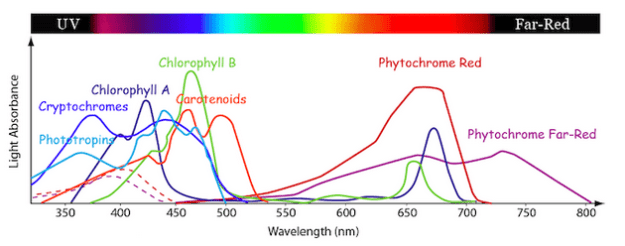
Plants use phototropins, phytochromes, cryptochromes and UV detectors to perform different light sensing tasks and to trigger signals throughout the plant.

Phytochromes are red and far-red light photoreceptors, whose role in plants is to detect favourable conditions for growth and to signal within the plant accordingly – five have been identified, known as phytochromes A to E.ref They function not just as light detectors but as temperature sensors since they are able to detect infrared light which is associated with heat.ref I was interested to read that phytochromes A, B and E stimulate lateral root production while phytochrome D inhibits it.

Phototropins are responsible for the phenomenon of phototropism whereby a plant grows towards the light – they contain blue light photoreceptors.ref Cryptochromes are another form of blue light photoreceptor only recently discovered, they’ve been shown to inhibit elongation of the germinating stem and to form an input to the circadian clock.ref

Several plant growth processes have been found to be initiated by UV-B light, summarised in this table but including stomatal closing and the production of compounds such as anthocyanins which protect the plant from damaging UV levels. UV-B light has been found to be detected in plants by a receptor known as UVR8ref.

So below there is a nice diagram put together by a producer of LED grow lamps (they’ve left the UV receptor off but everything else is there). As is clear to see, there is a wide range of spectra required by the different photoreceptor apparatus in a plant. So back to the whole point of this post – can you use artificial light? Well yes but for full functioning of your tree it should provide the spectra needed – which is basically most of the range of light from UV to infrared excluding green and yellow. The LED grow lamp seller has an article on finding lights which meet the requirements below (I do not know them, I just think their website makes sense).

https://www.ledgrowlightshq.co.uk/chlorophyll-plant-pigments/

The other factor to consider is that leaves are adapted to respond to the parallel rays of light from the sun. Their internal cell structure, for example, is organised to encourage the scattering of light to the spongy mesophyll cells which are underneath the palisade cells.ref In general a light bulb or LED light is not going to produce parallel rays of light so the photosynthetic efficiency of the light will be reduced (since less light will make it into the spongy mesophyll cells) and more power will be needed from the light.ref

Personally I’ve never used artificial light for a bonsai – the one indoor bonsai I have (a Ficus retusa) lives quite happily on a table near a window in my kitchen where it gets natural light throughout the day and copes with the large variations in photoperiod experienced in the UK. But theoretically it should be possible to use a light instead, assuming you have one which meets the requirements outlined in this post in terms of spectrum and intensity.

If you end up with a light which doesn’t reflect the spectra needed, this may impact your tree’s growth. For example “low blue light from warm white LEDs increased stem elongation and leaf expansion, whereas the high blue light from cool white LEDs resulted in more compact plants”ref – you can end up with ‘leggy’ plants if you don’t have enough light.

What each nutrient does (x17)

Understanding the exact role of individual plant nutrients is actually quite complicated. This is because many nutrients have multiple roles, and research hasn’t always clearly identified each role. It’s also because nutrients don’t act on their own – they usually form part of a larger molecule, such as an enzyme, and they usually interact with other nutrients, molecules and environmental factors such as pH. Then it requires diving deep to the molecular level to work out how chemical reactions take place and even how individual electrons move in the presence of the enzyme. I’ve read a bunch of papers and articles about the nutrients below but there is sure to be more out there – consider this a taster.

Macronutrients

Macronutrients are those inputs which plants require in substantial volumes in order to grow and metabolise. There are six macronutrients, of which three are metals.

1. Nitrogen: nitrogen is needed by plants for various reasons but one of the most important is for photosynthesis. Nitrogen is a component of chlorophyll, the green pigment in leaves which absorbs the energy from sunlight to break apart water in the photosynthesis reaction. The chemical formula of chlorophyll is C₅₅H₇₂O₅N₄Mg – as you can see both nitrogen and magnesium are needed in addition to carbon, hydrogen and oxygen which is obtained from air and water.

Secondly, nitrogen is a key component of amino acids, which are used in all living things to make proteins. There are 21 amino acids in plants which are connected together in a myriad of different sequences and shapes to make the different proteins. Examples of plant proteins include the storage material in seeds and tubers, plant cell membranes and the enzyme known as RuBisCO. RuBisCO is present in leaf cells alongside chlorophyll, and enables carbon fixation during photosynthesis – it is said to be the most abundant protein on Earth and represents 20-30% of total leaf nitrogenref. So photosynthesis requires chlorophyll and RuBisCO, both of which rely on nitrogen as a component element.

Finally nitrogen is present in the four bases used to create DNA (adenine, thymine, guanine & cytosine) and RNA (adenine, urasil, guanine & cytosine) which enables cell replicationref.

Nitrogen needs to be in soluble form to be used by plants, either as nitrate or ammonium, which requires the presence of specific bacteria either in the soil or in the plant’s roots. As I mentioned in my first post about nutrients, Hallé states that obtaining nitrogen is a constant challenge for plants. This is why the fertiliser industry is so prosperous – but unfortunately also so damaging for the environment. The Haber-Bosch process used to make Ammonia (NH3) is “one of the largest global energy consumers and greenhouse gas emitters, responsible for 1.2% of the global anthropogenic CO2 emissions”ref and nitrate runoff from highly fertilised fields damages rivers and ecosystems.ref The natural world has some clever ways to make nitrogen accessible – some plants incorporate bacteria into their roots which can do this, and in old growth Douglas fir forests, lichen in the canopy which contain cyanobacteria capture nitrogen from the atmosphere and when they fall to the forest floor they rot into components which trees can access (Preston, ‘The Wild Trees’). Similarly a relatively sustainable source of nitrogen for plants is rotting organic matter (along with the necessary microbes) – compost and manure are good options.

2. Phosphorus is needed in plants – and in fact in most living thingsbecause it’s a key component of the molecule used to store, transport and release energy in cells. That molecule is called adenosine triphosphate (“ATP”) and it’s created during photosynthesis by adding a phosphorus atom to adenosine diphosphate. The ATP can then be transported throughout the organism to be used where energy is required, at which point it’s converted to ADP (adenosine diphosphate) which releases energy back to the cell. Phosphorus also provides the structural support for DNA and RNA molecules, needed for cell replication.

For plants phosphorus is fundamental to photosynthesis, as a phosphorus-containing substance called RuBP (C5H12O11P2) is used to regulate the action of RuBisCO in fixing carbon from carbon dioxide.

Phosphorus is a key part of most fertilizers and manure is a good sourceref.

3. Sulphur is a constituent of two amino acids – methionine and cysteine. Cysteine is used to create methionine as well as glutathione, an anti-oxidant which helps plants defend themselves against environmental stressref. Methionine is involved in cell metabolism and the majority of its use in the cell is to synthesise ‘AdoMet’ which is used in methylation reactions (such as DNA methylation which regulates gene expression) and to create the plant growth regulator ethyleneref.

Manure is a source of sulphur for plants.

Metals

In addition to the top three outlined above, it turns out that plants need some atoms of various metals as well. In order to understand why, we need to know that plant cells are full of chemical reactions which perform all the different functions required for metabolism. Helping these chemical reactions along are a type of protein known as enzymes. Enzymes act as a catalyst to chemical reactions in cells, speeding them up without consuming the enzyme material itself. Some enzymes have metal ions at their heart which assist the reaction (called ‘co-factors’) and these play a critical role in the enzyme’s function (for example magnesium is used in RuBisCO).

Three of the six macronutrients needed by plants are metals – potassium, calcium and magnesium.

4. Potassium is one of the three major macronutrients usually found in NPK garden fertilisers (K is the chemical symbol for potassium), reflecting its important role across several different dimensions of plant growth. One important role is in the production of proteins. As outlined above, proteins make up a large part of plant biomass, and the key protein RuBisCO is necessary for photosynthesis. Proteins are manufactured on structures called ribosomes within the cell – and ribosomes need potassium in order to do their jobref.

The other important role for potassium is in providing the pressure within plant cells which keep them stiff and ‘turgid’ – without it they would become flaccid and the plant would fall over. The manipulation of turgidity within leaves is one way a plant controls the level of air coming into the leaf – to close off the air holes (stomata) the guard cells around the stomata are made more turgid which closes the gap between them. Potassium is involved in this process.

In nature the main source of potassium is the weathering of rocks, but it’s also contained in organic matter, particularly in seaweed.

5. Magnesium is a component of the chlorophyll molecule and is key to the operation of RuBisCO, both of which enable photosynthesis. It is found in soil from the weathering of magnesium-containing minerals – the University of Minnesota recommends dolomitic limestone or tap waterref.

6. Calcium isn’t just used for human skeletons, it’s also used for plant structure as it strengthens the cell walls in plants. Its presence (or absence) is also used for signalling of stresses to the plant, allowing it to activate defences against pathogens. Sources of calcium for gardening include lime or shells.ref

Micronutrients

Micronutrients are required in much smaller amounts than macronutrients, although they are still required.

7. Boron appears to have been identified as a plant micronutrient mainly due to the effects of not having enough of it, with researchers having observed that boron deficiency leads to root, leaf, flower, and meristem defects. The precise role that boron plays is not easy to find in the literature, other than it being generally agreed to be important as a structural component of the plant cell wall, helping to provide rigidityref. Boron also appears to be required for reproduction, and a lack of it can affect pollen germination, flowering and fruiting. Because boron has poor mobility in a plant and cannot be moved from one part of the plant to another, continued exposure to it is needed in order to avoid a deficiency – but the exact levels vary widely by plant.

Sources of boron include borax (sodium borate) but since boron toxicity is apparently possible at high levels be very careful with this approach. Obtaining boron from organic matter or liquid seaweed instead may be less risky.

8. Chlorine was added to the plant micronutrient list in 1946 since it was found that chlorine molecules are required as part of the machinery of photosynthesis – particularly relating to the water-splitting system. In addition to this essential function, chlorine has also been found to be beneficial at macronutrient levels, enabling “increased fresh and dry biomass, greater leaf expansion, increased elongation of leaf and root cells”ref.

Since most people will be using tap water for watering their bonsai, getting adequate chlorine to your trees should not be a problem, but if you are using rainwater perhaps consider tap water every now and then.

9. Copper is essential for plants because along with iron it makes up part of an enzyme called cytochrome oxidase which performs the last of a sequence of steps in respirationref. Cytochrome oxidase is present in the mitochondria of plant cells – these are separate organelles with their own unique DNA which are dedicated to energy production. Copper is also found in plastocyanin, a protein which is responsible for electron transfer in the thykaloid – the light-dependent part of the chloroplastref. This protein is key to the conversion of light energy to chemical energy in the cell during photosynthesis. Copper is found in the soil but apparently is deficient in soils with high amounts of organic matterref.

10. Iron is present in a large number of different enzymes within plant cells, appearing in chloroplasts (where photosynthesis takes place), mitochondria (where energy is created) and the cell compartment. Iron is therefore a key nutrient for growth and survival in plants – in just the same way it is with humans and other forms of life. Iron is a component of so many enzymes that there is a specific name for them – ‘FeRE’ or iron requiring enzymes (Fe is the chemical symbol for iron).

Iron can be toxic if too much is present, so plants have evolved mechanisms to remove it when it gets too high. ref1 ref2 ref3

11. Manganese is also a co-factor to enzymes involved in photosynthesis, as part of the ‘oxygen-evolving complex’ in photosystem II, which contains 4 manganese ions. Photosystem II “is the part of the photosynthetic apparatus that uses light energy to split water releasing oxygen, protons and electrons”ref.

12. Molybdenum is used by certain enzymes to carry out redox reactions (reactions where electrons are gained or lost from a molecule); these include nitrate reductase, xanthine dehydrogenase, aldehyde oxidase and sulfite oxidaseref. Its role facilitating the nitrogen pathway in a plant is important since nitrogen is the nutrient plants require the most of, and the presence (or absence) of molybdenum can make a big difference to the efficiency of nitrogen uptake which in turn affects growth rates and plant health.

13. Nickel is a co-factor to the enzyme urease which breaks down potentially toxic urea (a product of metabolism) into ammonia which can then be used as a source of nitrogen for the plantref.

14. Zinc is the final micronutrient alphabetically but not in terms of importance. It is associated with 10% of all proteins in eukaryotic cells including those of plants, assisting as a co-factor to many enzymes and so enabling many different biological processes including transcription, translation, photosynthesis, and the metabolism of reactive oxygen species. Zinc also plays a role in ensuring the correct folding pattern for proteins as they are created.ref

Interestingly, zinc deficiency is associated with smaller leaves and internodes, which you might consider a benefit for bonsai, but perhaps not at the expense of your trees’ core biological processes!

Wait – I only got to 14 and there are supposed to be 17 – what the heck? Oh yeah – here they are (15) carbon and (16) oxygen from carbon dioxide, and (17) hydrogen from water (H2O). Did you know that the oxygen emitted from plant photosynthesis actually comes from the water and not from the carbon dioxide? More in Photosynthesis.

Embolisms

You may have heard of embolisms in the context of humans – this is when an artery is blocked by something like a blood clot or a bubble of airref. A similar process can happen with trees and their xylem (water carrying) vessels.

As outlined in trees’ water system, water enters the tree’s root cells and is pulled in a continuous stream up through the xylem by the negative pressure created by leaf transpiration in the canopy. The xylem is actually a “continuous water column that extends from the leaf to the roots”.ref

If a bubble of air gets into the xylem, this breaks the water transport process and stops water from below the bubble being lifted any further. This stops water from reaching any parts of the tree dependent on the xylem cells which have been affected. Embolisms in trees are also known as ‘cavitation’. This process is even audible and apparently explains half of the sound heard from drying wood.ref

Thomas explains this really well in chapter 3 of his book in the section ‘Air in the system’. He says embolisms can occur from water in the xylem being under too much tension (ie. the tree becoming too tall or too high a rate of water being transpired), from xylem damage, or from freezing.

Embolisms are relevant to bonsai enthusiasts for two main reasons. Firstly they explain why a tree may die if it isn’t watered. When in leaf (for deciduous trees) and all the time for evergreens, transpiration will occur as water evaporates from the leaves through their stomata. If transpiration happens faster than the tree can replace water through its roots, embolisms can occur. If too many embolisms occur, the tree might not have enough routes for water to reach the cells, or enough volume of water to meet their needs.

The second reason why embolisms are interesting from a bonsai perspective is that they also explain the two very different xylem structures which can be observed between trees and which have implications for their growth behaviour.

All conifers and some angiosperms called ‘diffuse porous’ trees, add to their xylem network each year, and have many smaller, narrower, interconnected xylem vessels which don’t allow large air bubbles to form. These trees have active xylem in multiple rings (Thomas says that conifers can have 30-40 years worth of rings still actively transporting water up the tree). In cross-section they have small ‘pores’ and a denser consistency.

The alternative approach is taken by ring porous trees, which regrow their xylem vessels every year, and only ever have a single ring of much larger, longer super-pipes of active xylem transporting water. These trees can grow much quicker because their water transport is more efficient in the right conditions (ie. not freezing). But they can’t break bud until they’ve constructed the new year’s xylem. This explains why some species such as oak leaf out relatively late – they have to spend time at the beginning of the season regrowing their xylem ring. An evergreen tree cannot be completely ring-porous, because it would not be able to supply water to its leaves through the winter.

Like everything in nature there are trees which are combination of the two as well. There are some nice microscope images of the xylem vessels of different types of wood here. The difference in size between coniferous species (whose xylem cells are called tracheids) and angiosperm species (whose xylem cells are called vessels) is show in the table belowref:

As can be seen, conifers have tracheids which individually don’t get much longer than 2-3mm or wider that 10-12 μm (note that the table uses a logarithmic scale). Ring porous species on the other hand have vessels in the 1-12cm range in terms of length, and 20-80 μm wide.

The implication for this from a bonsai point of view is that even though our trees are small, for those species which are ring porous trees (mostly deciduous angiosperms) embolisms are perhaps even more of a risk. The scale at which we are working means there are only a small number of vessels available for water transport – a 20cm high tree might have single vessels all the way from root to crown. To mitigate this risk we should ensure these trees are well watered especially when it is hot or windy, and that they have the energy and nutrients to regrow their xylem every season.

I’m still trying to find a definitive source with a list of which species are ring porous and which are diffuse porous, but here’s what I’ve found so far (Ennos, Thomas, and some reference articles ref):

  • All conifers are diffuse porous, as they have tracheids (short & narrow) providing their water transport. Embolisms in these tracheids dissolve naturally due to their small size.
  • Diffuse porous angiosperms have narrower vessels – they are still vulnerable to embolism but less than ring porous trees, and have adapted mechanisms to resolve them, such as pumping water (sap) up from the roots to refill the vessels in spring (Ennos): poplars, beech, birch, maple,
  • Ring porous angiosperms have wide, fast flowing vessels and routinely get embolisms every winter, requiring a new set of vessels to be grown every year: oak, ash, black locust, catalpa, chestnut, hickory, mulberry,